Get Full Government Meeting Transcripts, Videos, & Alerts Forever!
Get email alerts on the Transportation Impact Analysis topic
No spam. Unsubscribe anytime.
Santa Rosa City staff urge clearer public messaging on traffic studies and caution against overreliance on models
Summary
At a June 4 meeting, staff explained that transportation impact analyses (TIAs) and Vehicle Miles Traveled (VMT) metrics are useful screening tools but are imprecise; staff proposed clearer public materials, possible higher thresholds for small projects, and regular validation of older studies.
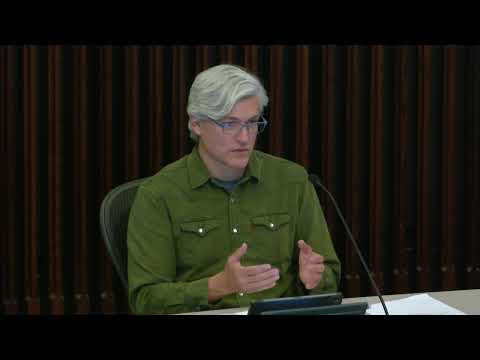
Santa Rosa City’s Design Review and Preservation Board heard a presentation June 4 from Dan Hennesy, the city’s transportation director in Public Works, who said transportation impact analyses (TIAs) and related traffic studies are valuable but limited tools for project review.
Hennessy told the board that TIAs typically forecast changes to vehicle movement and intersection delay and that, in California, analyses increasingly must account for Vehicle Miles Traveled (VMT) as a proxy for environmental impacts. He emphasized that models produce single-path projections with substantial uncertainty: “Those are numbers that have wide error bars attached to them,” he said, adding they “are not guarantees of future conditions nor should they be the sole basis for making any decisions related to the project.”
The presentation described customary mitigation—such as widening intersections or adding signals—and warned that such fixes can induce more driving. Hennessy said modern TIAs should be evaluated in the context of multimodal goals (pedestrians, bicyclists, transit) and safety outcomes and should align with overall city objectives, including compact infill and reduced VMT.
Board members pressed staff on community concerns tied to the 2017 Tubbs Fire and evacuations. Board member Fajent, drawing on personal experience during that event, asked whether TIAs can or should incorporate specific evacuation analyses. Hennessy replied that the city coordinates roadway changes with fire and police, uses ‘‘flush plans’’ (signal timing that creates a series of greens to move traffic away from hazards), and that some emergency measures (for example coordinated signal timing and dedicated emergency operations staffing) were not in place in 2017 but have since been implemented.
Board members and staff discussed how TIAs are scoped and validated. Hennessy said typical practice is to collect counts on a representative weekday (Tuesday–Thursday), analyze AM and PM peak hours, and validate models against observed counts; more complex projects may require multi-day counts. He said a traffic study the city accepted within the previous two years remains presumptively valid but may be re-evaluated if conditions have changed.
On the subject of thresholds, Hennessy said staff is considering raising the analysis thresholds for smaller projects because a review of recent TIAs found that “more than 90% of them didn’t tell us anything that we didn’t already know.” He framed thresholds as policy choices that differ across jurisdictions and urged the board to weigh the cost and benefit of added analysis versus the burden on applicants and staff.
City planning staff, represented in the meeting by Jessica Jones, deputy director of planning, said the department holds pre-application neighborhood meetings where planning, transportation and fire staff answer residents’ questions and that the city is exploring one-pagers or short written responses to improve public communication. Hennessy said he would present the same overview to the Planning Commission next week and staff is discussing whether to brief the City Council or produce clear public-facing materials.
The board did not take any formal action on the item. The chair closed public comment on the presentation and adjourned the meeting.