Get Full Government Meeting Transcripts, Videos, & Alerts Forever!
Get email alerts on the Stormwater Grant topic
No spam. Unsubscribe anytime.
Regional planner details CDBG stormwater planning grant for Kirklin; residents raise concerns about county-managed tiles and local fees
Summary
Tim Carson of the North Central Indiana Regional Planning Council outlined a CDBG-funded stormwater planning grant Kirklin is pursuing, with a July 10, 2026 application deadline. Residents provided detailed local evidence of flooding, alleged county use of Kirklin’s stormwater fee for farm tile work, and urged quick fixes alongside the study.
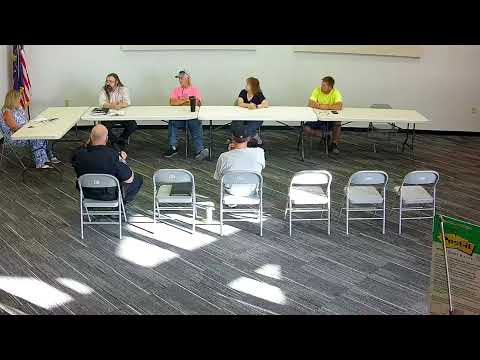
Tim Carson, a planner with the North Central Indiana Regional Planning Council, told Kirklin meeting attendees that the town is seeking a Community Development Block Grant (CDBG) planning award to fund an engineering study of local stormwater infrastructure and options to reduce flooding. Carson said the planning grant is administered by the Indiana Office of Community and Rural Affairs and funded with federal CDBG dollars. He said Kirklin’s low- and moderate-income share is 53.85 percent and the town is applying for $27,000 of a maximum $30,000 planning award, with a required minimum local match of 8 percent and roughly $5,000 expected to come from the town’s stormwater utility operating fund.
The grant application deadline is July 10, 2026; Carson requested additional letters of support by about July 8 and said award notifications typically follow in August or September. He said the planning work would include an assessment of existing facilities, identification of service needs, cost analysis and maintenance recommendations, and that engineers are required to provide at least three possible options to address flooding issues.
The presentation prompted extended public comment focused on persistent flooding problems in specific neighborhoods and an allegation about fund use. Several residents described recurring basement flooding, standing water in yards and parking lots, sinkholes and deep holes near town limits, and evidence from limited camera inspections showing sediment and root intrusion. One resident said informal dye tests had shown flow between structures in town and cited multiple locations where risers and clay tile remain visible or are buried under farmland. Residents urged that the engineer meet with local people who know trouble spots as part of the study.
Residents also alleged that county officials or contractors had previously diverted Kirklin’s $5-per-parcel storm drain fee to field tile work benefiting farmland instead of maintaining the town’s drains. "All of a sudden that money's been used by the county instead of for Kirklin," one commenter said, and speakers reported raising the concern with the town attorney and at a county commissioner meeting, where they said Commissioner Dan Sheets told them the county 'didn't have the funds.' Carson said the county is studying what it needs to study and that Kirklin can pursue a separate town project or potentially coordinate a joint county–town project depending on what the county’s study finds.
Speakers described specific technical problems: many county tiles appear to be old (residents estimated at least 100 years in some places), some tiles are undersized for current drainage needs (residents contrasted four- and six-inch tiles with a suggested 12-inch minimum for heavily served areas), and past emergency repairs by the state that dumped gravel and paved over sinkholes have, residents said, altered drainage patterns and created new problems. Residents also described instances where farmers have patched into or cut through county tiles during field work, complicating system capacity and maintenance.
Carson said the planning grant process now includes an OCR community liaison for each county; he and local officials planned a meeting with the liaison the following Monday to review changes to OCR procedures and Kirklin's community resiliency score. He said he would draft a resiliency action plan from the meeting discussion for Kirklin officials to review and sign as part of the application. Carson also encouraged residents to submit written comments if they wanted them included in the record; the clerk said no written comments had been submitted for this hearing.
No formal vote on the grant application occurred at the meeting. Carson closed by reiterating his intention to support Kirklin’s application and to work with both the town and county if coordination proved most effective; the presiding official then adjourned the meeting.