Get Full Government Meeting Transcripts, Videos, & Alerts Forever!
Get email alerts on the Energy Finance topic
No spam. Unsubscribe anytime.
Mass. energy office recommends portfolio of tools to pay for grid upgrades, prioritizes demand reduction
Summary
The Office of Energy Transformation's Financing the Transition work group recommended using a mix of financing mechanisms (securitization, bonds, state revolving funds, leases, tariffs and others) and emphasized DER aggregation and peak demand reduction to avoid costly distribution investments and limit bill impacts.
Katherine Omali, deputy executive director in the Office of Energy Transformation, opened a webinar laying out the results of the Financing the Transition focus‑area work group and said the office created the group to help plan for the large distribution‑system investments needed to meet the Commonwealth’s clean energy and climate mandates.
“The Office of Energy Transformation was started in May of 2024 to help enable the hands‑on execution of the clean energy transition,” Omali said during the webinar. The group’s work, she said, was stakeholder‑driven and affirmed by the Energy Transformation Advisory Board.
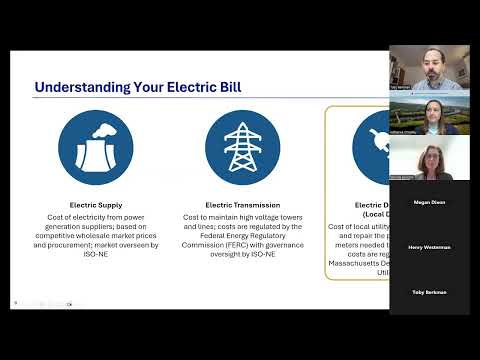
The presenters summarized a three‑phase process: catalog investments and how they are paid for today, assess alternative financing structures qualitatively and quantitatively, and develop findings and recommendations. Melissa Lavvenson, who leads the office, noted the group focused on distribution costs because those are the components of retail bills the state can most directly influence and because accelerating investments could put upward pressure on ratepayer bills.
The work group reviewed nine alternative tools — including securitization, energy‑transition bonds, a state revolving fund, distribution entitlement leases, clean‑energy distribution tariffs, public–private partnerships, climate “super‑fund” models, carbon fees and distributed energy resource (DER) aggregation — and ran them through 23 qualitative criteria as well as scenario modeling. Toby Burkeman, lead facilitator from the Consensus Building Institute, described the modeling: for a hypothetical $1 billion distribution investment, alternative approaches produced estimated lifetime ratepayer savings that ranged from about $215 million to $725 million under the Analysis Group’s assumptions; presenters said results depend on market conditions, scale of tool use and modeling choices.
The group’s key conclusions were: a portfolio approach is most likely necessary because no single tool solves every problem; financing‑focused tools (for example, securitization) can produce incremental savings but depend on careful design and market conditions; new revenue sources (for example, a climate super fund or carbon fee) could yield larger bill impacts but face legal and political hurdles; and DER aggregation and other non‑wires alternatives showed strong potential to avoid investments altogether and thus reduce overall system costs.
Presenters emphasized the need to engineer social equity into any financing design so benefits reach low‑ and moderate‑income households and environmental‑justice communities rather than leaving distributional burdens unaddressed. They also cautioned policymakers to evaluate unintended consequences, such as impacts on utility credit ratings or taxpayer exposure.
As a result of the group’s work and similar findings in related focus areas, the advisory board approved sunsetting or refocusing several groups and launching a single new focus area on peak energy demand reduction to coordinate strategies to avoid future infrastructure costs and meet a goal tied to the governor’s executive order that targets demand reduction by 2035. Lavvenson said the new focus area will launch with a webinar in July and will pursue a phased approach similar to the group that produced today’s findings.
Materials including the full report and appendix will be posted on the Office of Energy Transformation website; presenters encouraged attendees to sign up for the forthcoming peak demand webinar.