Get Full Government Meeting Transcripts, Videos, & Alerts Forever!
Get email alerts on the Parking Policy topic
No spam. Unsubscribe anytime.
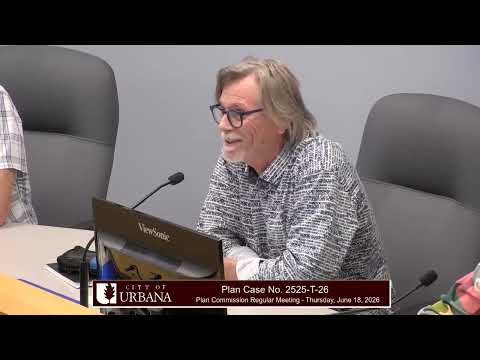
Urbana plan commission forwards zoning change to align city code with 'People Over Parking' law
Summary
The Urbana Plan Commission voted to forward a text amendment (plan case 2525‑T‑26) that inserts statutory definitions and a parking exemption tied to state law (SB211). Commissioners asked staff to clarify map-update timing, potential hotel exceptions and developer predictability before council review.
The Urbana Plan Commission voted to forward plan case 2525‑T‑26 to city council with a recommendation of approval. The amendment adds definitions from the state People Over Parking Act and a note in the zoning ordinance stating no minimum automobile parking may be required for projects located within 1/2 mile of a public transportation hub or 1/8 mile of a public transportation corridor, as defined in the statute.
Staff, speaking as the presenter, summarized the state law (SB211), noting it passed the general assembly on Oct. 31, was signed Dec. 16 and took effect June 1. Staff said the ordinance text copies the legislation’s definitions and that the displayed map shows corridors and hubs based on combined bus frequencies of 15 minutes or less during morning and afternoon peak periods. "The People Over Parking Act states that, except as otherwise provided, a unit of local government may not impose or enforce any minimum automobile parking requirements on a development project if the project is located within 1/2 mile of a public transportation hub or 1/8 mile of a public transportation corridor," the staff presenter said.
Why it matters: The change is intended to bring Urbana’s zoning code into compliance with state law and to reduce minimum‑parking barriers near high‑frequency transit corridors and hubs, supporting walkability and infill consistent with Imagine Urbana policies.
Key discussion: Commissioners focused on operational questions. Plan Commissioner Mr. Fel said dividing small blocks so that some parcels fall inside the statutory buffers while adjacent parcels do not “feels kind of punitive to the people that live there,” and asked how staff would manage frequent changes to MTD (Mass Transit District) route schedules. Staff replied the map was prepared using the University of Illinois semester schedules and the highest‑service measures to produce a stable baseline and that because this is a text amendment the map can be updated administratively; staff recommended documenting that the map reflects the highest‑service schedule in a given year.
Commissioners also asked about statutory exceptions, noting the statute’s definition of a "development project" may exclude hotels and similar transient lodging. Staff acknowledged they had not fully vetted every exception and agreed to review the hotel/transient‑lodging language before council consideration. Several commissioners suggested staff could consider broader policy options — for example, applying the change at a neighborhood or zoning‑district scale — but the prevailing view was to forward a narrowly compliant text amendment and let council and future studies consider broader approaches.
Vote and next steps: The commission moved to forward plan case 2525‑T‑26 to the city council with a recommendation of approval (motion by Plan Commissioner Mr. Fel; second by Plan Commissioner Mr. Andre). Roll call recorded affirmative votes from Mr. Andre, Mr. Fel and Mr. Alred; the staff presenter said the item will be introduced at the July 6 committee‑of‑the‑whole meeting and set for final action on July 13.
What remains: Staff will review the statute’s exceptions (for example, hotel uses) and consider clarifying text about which service schedule the map relies on and how often it will be updated. Those clarifications were requested by commissioners but were not formal conditions of the motion.