Get Full Government Meeting Transcripts, Videos, & Alerts Forever!
Get email alerts on the Climate Action Plan topic
No spam. Unsubscribe anytime.
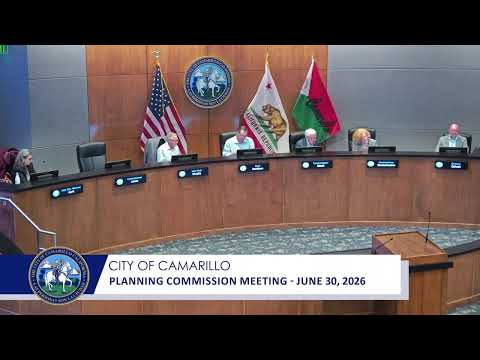
Planning Commission backs CEQA-exempt Climate Action Plan, recommends City Council adoption
Summary
The Planning Commission voted 4–0 to find Camarillo’s Climate Action Plan exempt from CEQA under Guideline 15061(b)(3) and recommended the City Council adopt the plan. Consultants said the plan is CEQA-compliant but not CEQA-qualified and described it as a "living document."
Hannah Mains, a consultant with Rincon Consultants, said Camarillo’s draft Climate Action Plan updates metrics for water, waste and transportation, and that the plan’s CEQA review resulted in a categorical exemption. “It is not a qualified climate action plan,” Mains said, adding that the document is intended to be a living plan the city will monitor and update as conditions change.
Jackie, representing city planning staff, told the commission staff’s recommendation was that the Planning Commission “find the climate action plan exempt from review under California Environmental Quality Act pursuant to section 15061(b)(3) of the CEQA guidelines, and adopt a resolution recommending approval of the climate action plan to the city council.”
Mains explained why the plan was not presented as a CEQA‑qualified plan: achieving the deep reductions tied to a qualified plan (for example, 40% below 1990 levels) is increasingly difficult within current timeframes and technological constraints, and some measures (such as appliance mandates) would require ordinances or other actions beyond the scope of the plan. She said state-level policies (including Pavley standards, SB 100 and other clean‑car and renewable portfolio standards) reduce the gap the city must close and that the plan focuses on measures the city can realistically implement in the near term.
During discussion, commissioners asked about the plan’s sensitivity to ongoing water litigation and about a chart showing ‘‘target pathways.’’ In response, Mains said the plan is designed to be monitored and adjusted and that the graph’s ‘‘adjusted forecast’’ line incorporates expected state action; the difference between that line and the target line represents what the city must achieve locally.
The commission closed public comment after being told no members of the public wished to speak. A motion to follow staff recommendations — to find the plan exempt under CEQA and to adopt the resolution recommending approval to the City Council — was seconded and approved 4–0. The record lists Commissioners Vandermuelen, Edsel, Vice Chair Murphy and Chair Davidson as voting yes.
Next steps: staff will forward the Planning Commission’s recommendation and the resolution to the City Council for consideration at its upcoming meeting. The plan’s authors and staff said they will continue quarterly or annual monitoring and return with updates as new data and technologies emerge.