Get Full Government Meeting Transcripts, Videos, & Alerts Forever!
Get email alerts on the Land Use topic
No spam. Unsubscribe anytime.
Spokane County planners present draft EIS and proposed neighborhood zoning; public comments due July 11
Summary
Spokane County planning staff outlined a draft environmental impact statement with three growth alternatives and proposed 'neighborhood residential' zoning to encourage mixed-use, walkable neighborhoods while protecting farms and critical areas; staff asked residents to file comments by noon July 11.
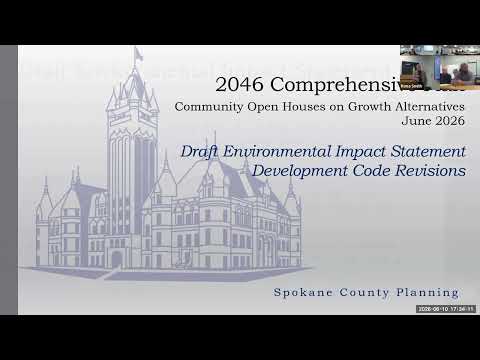
Spokane County planning staff presented a draft environmental impact statement and a proposed new "neighborhood residential" zoning framework at a public open house, and asked residents to submit comments by noon on July 11. Scott Chesy, a Spokane County planner, led the presentation and described three alternatives for accommodating roughly 104,000 projected new residents over 20 years.
Why this matters: The county is balancing state-driven density mandates and local market preferences while trying to protect farmland, wetlands and groundwater. The draft EIS and zoning changes would affect where housing and mixed-use development can occur across multiple urban growth areas, including the West Plains, Airway Heights, Five Mile Prairie and parts of the North Metro area.
Chesy summarized the three EIS "bookend" alternatives: one that emphasizes infill and higher densities in existing urban growth areas, an alternative reflecting recent historic patterns (about 4.5 housing units per acre) that relies on some expansion, and a no-change scenario. He told attendees, "Comments are due no later than noon on July 11th," and walked through maps showing which urban growth areas were ranked high, medium or low for potential growth.
The staff presentation proposed replacing the current low/medium/high residential (LDR/MDR/HDR) designations with a two-tier "neighborhood residential" system (NR1 and NR2) plus a neighborhood business zone. Chesy said NR1 would largely preserve existing single-family patterns while allowing limited infill; NR2 would be a master-planned option allowing a broader mix of housing types and small businesses. He described the approach as a way to "let builders gauge where the market is" while providing clearer rules to reduce permitting uncertainty.
Public concerns focused on infrastructure, critical-area protections, and rural preservation. Residents asked if sewer and water in the West Plains would be provided by the county or the city; Chesy explained the city of Spokane often has the first right to serve in the area and that many potential expansions would connect to city utilities. On groundwater, Chesy said Ecology has declared the Spokane Valley–Rathdrum Prairie aquifer closed to new water-rights issuance, and he noted that Ecology still issues certain permit‑exempt wells (limited to about 5,000 gallons per day for a parcel) under current rules.
Wetlands and stormwater were another focal point. Staff showed flood- and wetland-risk mapping prepared by Chad Pritchard and discussed wetland mitigation banks; attendees questioned whether mitigation banks preserve local water quality, and staff explained that wetland-fill permitting is handled through the state Department of Ecology and that mitigation ratios and site-selection rules apply.
Energy and large technical facilities drew repeated questions. Chesy said the county is beginning work on an energy ordinance to guide siting of large wind or solar facilities, but that state siting processes can supersede local codes for some energy facilities. Data centers prompted concerns from attendees about water demand and noise; Chesy said the county has had inquiries but no formal permitting applications in its permitting office and is starting to update code to address potential impacts.
Several residents, including a farmer who spoke during public comment, emphasized farmland preservation. The farmer said, "Once there's pavement, it will never go back," and urged the county to prioritize agricultural protections. Chesy responded that farmland preservation is a top priority for the plan and that staff are coordinating with agricultural stakeholders, the Farm Bureau and the Spokane County Cattlemen.
Next steps: staff will present findings to the planning commission and the Board of County Commissioners; Chesy said the board is expected to narrow a preferred alternative in early July and that the staff will then undertake a second, more detailed round of technical analysis (transportation, sewer and water) based on the preferred pattern. The county is holding additional open-house events and has posted maps and draft chapters for public review.
Contacts and comment instructions: The county provided multiple ways to submit written comments and said staff and maps would be available at a follow-up open house; see Spokane County Planning's published notice for exact submission instructions and locations where maps can be reviewed.