Get Full Government Meeting Transcripts, Videos, & Alerts Forever!
Get email alerts on the Budget Prioritization topic
No spam. Unsubscribe anytime.
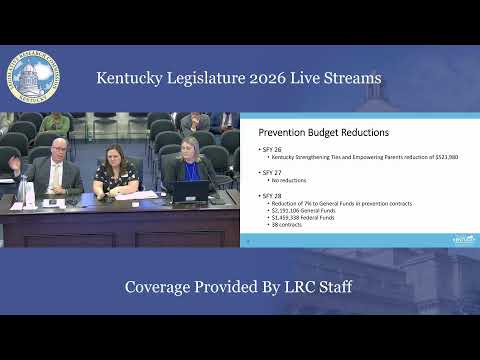
Lawmakers press Cabinet on how prevention dollars will be prioritized as possible contract cuts loom
Summary
Committee members asked how the Cabinet will choose which prevention contracts to reduce if across‑the‑board cuts occur, sought program‑level metrics and questioned the decision to reposition Wendy’s Wonderful Kids specialists rather than maintain the program as funded by the Dave Thomas Foundation.
Members of the Budget Review Subcommittee pressed Cabinet and DCBS leaders for greater transparency about how prevention contracts would be chosen if cuts are required and for clearer measures of program success.
Representative Heffron told the committee she wants closer dialogue with the cabinet and offered to help prioritize services, saying, "I'm opening the door publicly to say, let's sit down and have actual conversations of what we can do to help foster care kids." Several members said an across‑the‑board 7% hypothetical reduction (presented as a mathematical example covering 38 prevention contracts) risked cutting high‑performing programs and that targeting by performance would be preferable.
On staffing and program structure, lawmakers asked about the Wendy's Wonderful Kids program, which involves specialists funded through the Dave Thomas Foundation to help children with a termination of parental rights find permanency. Agency staff said the specific contract structure may not be replicated if funding is constrained but that no employees would be terminated; instead some non‑case‑carrying specialists could be redeployed into frontline casework so the core adoption and permanency work continues, even if not under the same program label.
Secretary Stack acknowledged the difficulty of prioritizing within a large cabinet and said the department aims to fund higher‑performing programs while reducing lower‑performing ones where necessary: "If there's an underperforming program and that program is the one that needs to end, I will do my best to try to maximize the resources for the high‑performing investments and reduce the investments for the lower‑performing ones." He also noted that budget mechanics — line items, earmarks and whether additional resources were provided — constrain what can be fulfilled.
Members asked the cabinet to provide the committee with the packet materials that list programs funded by Title IV‑E and to follow up with meetings to discuss prioritization and program outcomes. The cabinet agreed to provide additional details and to meet with members to walk through funding, claiming and program lists.
The committee also heard a brief update on SNAP administrative error rates: staff said Kentucky’s error rate was below the penalty threshold so the state will not owe the additional penalty next federal fiscal year, though an increase in administrative match requirements remains in effect.