Get Full Government Meeting Transcripts, Videos, & Alerts Forever!
Get email alerts on the Child Welfare Prevention topic
No spam. Unsubscribe anytime.
Kentucky officials say Family First prevention expansion is reducing foster care entries and increasing federal drawdown
Summary
At a Budget Review Subcommittee hearing, Cabinet and DCBS officials described Kentucky’s Family First prevention programs, reporting increases in families served, high Title IV‑E prevention drawdown and a pending plan to broaden candidacy so more children can access services earlier.
Kentucky’s Cabinet for Health and Family Services told a legislative budget subcommittee that investments in Family First prevention programming have helped serve more families and reduce foster‑care entries while allowing the state to draw down a larger share of Title IV‑E prevention funds.
Secretary Steven Stack said Kentucky launched its Title IV‑E prevention program in October 2019 and “was the fifth state in the nation to receive federal approval for our prevention plan,” and that the state now has the highest percentage of Title IV‑E prevention funding drawdown in the country. He described a strategy of implementing evidence‑based practices within existing programs and improving automation to maximize federal claiming.
Officials walked lawmakers through a prevention continuum — primary supports such as child care and housing, secondary targeted services and tertiary interventions for families already involved with the Department for Community Based Services (DCBS). Stack and DCBS staff said the cabinet is seeking federal approval to expand the program’s candidacy definition so children and families not already involved with DCBS could access services earlier.
Agency leaders presented program inventories and regional coverage, noting that Family Preservation and Reunification and the INTERCEPT in‑home program are statewide, while programs such as Kentucky Strengthening Ties and Empowering Parents (KSTEP), high‑fidelity wraparound and multi‑systemic therapy operate in selected service regions. Staff said prevention services have scaled steadily: across several fiscal years the number of families served increased by roughly 1,000 to about 4,000, with about 90% of children remaining in their homes at program closure.
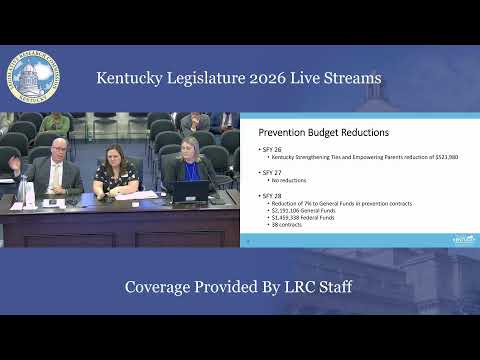
Budget slides showed out‑of‑home care costs rose by roughly $88 million between FY21 and FY25 while prevention funding rose by just under $47 million. DCBS reported Title IV‑E prevention drawdown totals just under $100 million for state fiscal years covered. Officials cautioned that rising out‑of‑home costs reflect multiple factors — per‑diem rate increases, Medicaid decertification costs and higher acuity among children in care — which complicate measuring net downstream savings from prevention investments.
When asked how Kentucky draws a high share of Title IV‑E prevention claiming, Stack credited implementation within existing programs, adoption of evidence‑based practices and the $20 million appropriation in House Bill 1 (2022) that allowed the state to match and draw down additional federal funds.
DCBS officials said some pandemic federal dollars (about $4.3 million) were used for prevention and explained that those funds cause totals on different slides to appear inconsistent. They emphasized the department’s request to federal partners to allow claiming for broader secondary prevention populations to divert families from deeper child welfare involvement.
The cabinet also described program outcomes and monitoring approaches. Officials said typical metrics include the percentage of children remaining in the home at discharge, six‑month and 12‑month post‑discharge status and program‑specific measures (school enrollment, employment and placement stability). For the family preservation program, DCBS cited figures near 97% at closure, about 93% at six months and about 90–91% at 12 months post‑discharge.
Lawmakers asked for detailed program‑level outcomes and cost data to better tie prevention investments to downstream savings. Cabinet officials said they can provide additional outcome data and invited further meetings to walk through program lists and claiming details.