Get Full Government Meeting Transcripts, Videos, & Alerts Forever!
Get email alerts on the Oversight And Implementation topic
No spam. Unsubscribe anytime.
Lawmakers press CPE on advising, teacher preparation, dual credit transferability and institutional risk
Summary
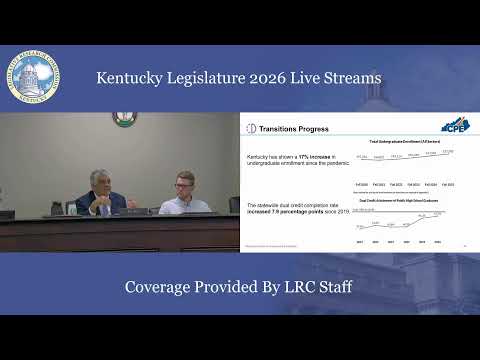
Members questioned CPE staff about coordination among K‑12 advising efforts, teacher‑prep quality (LETRS/letters training), dual credit transferability and how CPE monitors institutional financial health; CPE said it has visited 85% of districts, is reviewing dual credit courses for transferability, and relies on data systems to spot risks.
During a question-and-answer period following the CPE presentation, members of the Budget Review Subcommittee asked about specific implementation and oversight issues.
Representative McCool opened the exchange by thanking presenters for the briefing and praising CPE’s dual‑credit and job‑placement transparency work. Representative Tipton asked whether advising efforts (local counselors, district programs and the Kentucky Advising Academy) were sufficiently coordinated; Amanda said CPE has visited about 85% of school districts, is developing a scope and sequence in partnership with KDE, and is working to align messaging and FERPA processes so families understand approvals required for proactive outreach.
Tipton and other members raised teacher‑preparation concerns and asked what could be done to improve readiness. Powell and Amanda pointed to external evaluations at EPSB, urged deeper reviews of quality (not just program completion), and cited LETRS (referred to in the transcript as letters training) as an evidence‑based approach where stronger faculty adoption and improved practicum experiences can help pre‑service teachers enter the classroom better prepared.
Members also raised financial and competitive concerns. Representative Brown and others said robust state support for public institutions can pressure small private colleges; presenters said state aid is portable to institutions students choose, but agreed to consider targeted supports and noted that CPE reviews institutional financial certifications annually and is monitoring financial health (including work with Kentucky State University directed by the legislature).
A member asked whether Kentucky has seen problems with so‑called 'ghost students'—fraudulent enrollments using stolen or synthetic identities to capture federal Pell funds. Powell said he had not been made aware of significant issues raised by campuses in Kentucky and that campuses report verification and engagement processes for online and other students; he encouraged institutions to alert CPE if problems arise.
Several lawmakers requested follow‑up: more detailed dual‑credit transferability lists, additional information on teacher‑preparation program quality and more granular financial‑health indicators for institutions. The subcommittee adjourned after these exchanges.
Votes and formal actions recorded during the meeting included approval of the minutes by voice vote earlier in the session.