Get Full Government Meeting Transcripts, Videos, & Alerts Forever!
Get email alerts on the Postsecondary Education topic
No spam. Unsubscribe anytime.
Council on Postsecondary Education outlines role, programs and goals to budget subcommittee
Summary
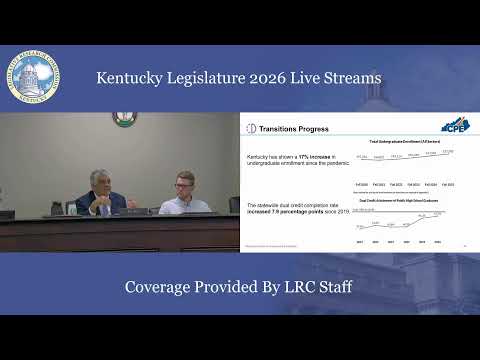
Council on Postsecondary Education staff told the Budget Review Subcommittee that CPE’s statutory authority (KRS 164.020) centers on system coordination, budget requests, academic approvals and workforce alignment; presenters highlighted GEAR UP, the Kentucky Advising Academy, Futurity, a healthcare workforce collaborative and progress on the '60 by 30' attainment goal.
Travis Powell and Dr. Ellis of the Council on Postsecondary Education presented an overview of CPE’s statutory role and programs to the Budget Review Subcommittee on Education, citing KRS 164.020 as the primary statutory authority that defines much of the council’s duties.
Powell told members that the council’s responsibilities fall into four broad areas: coordinating Kentucky’s postsecondary system, advising the General Assembly and the governor on higher‑education policy and finance, developing the consolidated budget request for higher education and measuring performance, and maintaining a student information system to guide policy. “We have a really robust student information system,” Powell said, adding later, “We have the best data system in the country,” referring to Kentucky’s linked longitudinal data and KY STATS reporting.
Presenters described CPE’s governance work and staffing: the agency reported roughly 109 employees overall, with about 43 general‑fund positions and the remainder supported by federal or private grants (including federal GEAR UP funding). Powell explained that Kentucky uses both governing and coordinating boards (for example, the Kentucky Community and Technical College System has a governing board), and he referenced the 1997 reconstitution under House Bill 1 and a more recent change under House Bill 619.
Amanda from CPE reviewed several initiatives aimed at improving access and completion. She said Kentucky recently received its fifth federal GEAR UP award, a planned seven‑year grant aimed at under‑resourced cohorts. Amanda also described the Kentucky Advising Academy (KAA), a new scope and sequence for grades 6–12 developed in partnership with KDE, and the Kentucky Student Success Collaborative, which focuses on wraparound supports and campus‑level interventions.
On affordability and outcomes, Amanda reported that the student debt burden at graduation for public institutions has fallen to $10,168 and that about six in 10 Kentucky undergraduates graduate debt‑free, outcomes she attributed to expanded state and federal aid and campus scholarship efforts. Powell clarified later in the session that the $14,000 figure mentioned elsewhere refers to the average debt among those graduates who carry any debt (the figure excludes graduates with zero debt).
The presenters highlighted workforce initiatives, including a healthcare workforce collaborative and a relatively new CPE workforce unit intended to strengthen employer engagement and align credentials with labor‑market needs. They described the Graduate Profile (10 essential workforce skills being embedded into general education), expansion of stackable credentials and tools such as Futurity (which Amanda said has had about 60,000 unique users, 40,000 of them Kentucky residents, and will add a lifestyle calculator and quiz features linked to KY STATS data).
The overview closed with a summary of CPE’s role on tuition approval and performance funding (Powell said a performance‑funding work group had convened with a report due Dec. 1) and a reminder that CPE approves tuition rates for public institutions and manages the consolidated budget request on behalf of higher education.
A procedural motion to approve the minutes from the last meeting passed by voice vote earlier in the session. The subcommittee adjourned after a period of member questions about advising, teacher preparation and institutional financial oversight.