Get Full Government Meeting Transcripts, Videos, & Alerts Forever!
Get email alerts on the Lcp Cap Management topic
No spam. Unsubscribe anytime.
San Mateo County lays out six options to address coastal 40‑unit permit cap after 2025 surge
Summary
County planning staff told residents the county exceeded its 40-unit coastal annual permit cap after a 71‑unit affordable project and outlined six alternatives — including a permit waitlist, forward-averaging triggers and a banking look‑back — to avoid a required coastal amendment that would raise the cap.
SAN MATEO COUNTY — At a public meeting convened to explain why building permits were halted on the mid‑coast, county staff and Supervisor Mueller outlined six alternatives to manage a sudden surge in approvals that pushed 2025 permit counts far above the Local Coastal Program (LCP) annual cap of 40 units.
Supervisor Mueller opened the meeting and urged community input, saying the goal was to find a community-supported solution. "If we get consensus built around that, the board will support whatever we come up with as a community," she said.
Steve M., director of the Planning and Building Department, told residents the department did not propose the large permanent increases attributed to it in an online report: "It asserted that we were proposing to increase the cap to 75 units per year and that is not the case," he said. Staff framed the discussion as seeking near-term fixes to avoid a mandatory Coastal Commission action that would require the county to amend its coastal plan and raise the cap by roughly 50 percent.
Why the change: staff said a large affordable project (described at the meeting as a 71‑unit project) and other approvals brought 2025 totals to about 102 units, well over the 40‑unit limit. Under current LCP averaging rules, that excess must be averaged across the housing element period or the county must pursue a coastal amendment. Staff said the county stopped accepting new building‑permit applications for new units to prevent uncontrolled issuance while staff develops a plan.
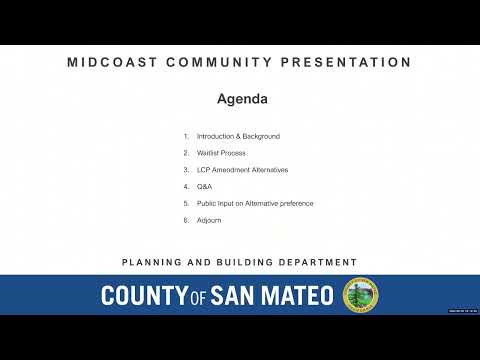
The six alternatives presented were: no change (pursue a formal amendment to the LCP and accept the longer timeline); fully exempt affordable housing from the cap (staff said this is complex and time‑consuming); two forward‑looking averaging approaches (an automatic temporary increase and a tiered trigger); and two look‑back/banking approaches (averaging unused credits back to 2013 or a 10‑year rolling look‑back). Staff said the look‑back option presented to the planning commission would use unused, unrealized permit credits to smooth the immediate overflow without a permanent cap increase.
Camille Leon, a county planner, described how the proposed waitlist would work for projects that complete planning review: "we will take your CDX approval date ... and it'll be first come first serve," she said, adding that cancelled or near‑ready building applications would be prioritized when permits resume. Staff also said projects that are already vested would keep their code protections.
Residents pressed officials on infrastructure and safety issues, including sewer overflows, traffic and wildfire evacuation. One attendee asked whether the county should improve infrastructure before increasing permits; staff replied that infrastructure constraints are part of why the cap exists but that many proposed fixes (for example, storm and wastewater upgrades or a transportation management plan) would take longer than the county has before the next permit year. County staff said emergency management and fire officials are working on shelter‑in‑place and evacuation planning.
On equity and process, residents asked whether banking unused permit credits would advantage large developers. Staff said banking is administratively simpler but acknowledged community concerns about how credits would be allocated; they suggested policy language could limit how banks are used. At the meeting staff gave rough figures for unused credits (on the order of 166–182 units depending on the look‑back window).
Next steps: staff asked the room to register a one‑question preference via a QR code and said they will summarize the public feedback, return recommendations to the Mid Coast Community Council and then to the Board. Any approach that changes the cap in the LCP will require submission to and approval by the California Coastal Commission.
The meeting included an extended public Q&A but did not record a formal vote; staff said they are preparing materials for the Board and for any Coastal Commission filings required by the option the county ultimately pursues.