Get Full Government Meeting Transcripts, Videos, & Alerts Forever!
Get email alerts on the Fepp Implementation Plan topic
No spam. Unsubscribe anytime.
Council committee reviews FEPP levy implementation plan as providers urge stronger support for family childcare and community schools
Summary
Central staff outlined changes to Seattle’s Families, Education, Preschool, and Promise (FEPP) levy implementation and evaluation plan; councilmembers pressed on a two-year school meals pilot funded by levy reserves and asked for clarity on program design while providers urged explicit inclusion of family home childcare, community schools, restorative practices and clearer contracting for local partners.
Seattle — Council Central Staff briefed the Select Committee on the Families, Education, Preschool, and Promise (FEPP) Levy on the implementation and evaluation plan on June 30, highlighting added program detail, reporting indicators and new limits on department flexibility, while community providers urged the council to strengthen supports for family childcare and community-centered models.
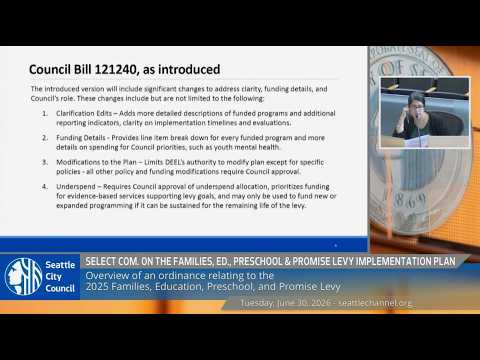
At the meeting, Jasmine Marwaha and Traci Ratzliff of Council Central Staff summarized the I&E plan’s revisions to the version transmitted by the executive, saying the introduced plan expands narrative descriptions of funded services, adds line-item spending details and requires council approval for many changes the executive could previously make unilaterally. Marwaha said the levy, approved by 80% of voters in November, is expected to generate about $1.3 billion over six years and that the plan keeps the same investment areas while shifting some program buckets and labor costs for clarity.
Why it matters: the plan governs how levy proceeds are allocated and measured across six years. Councilmembers said clearer language and measurable equity outcomes matter because the city will evaluate programs annually and the council will approve budgets and any new programs.
Public commenters representing childcare providers, restorative-practice partners and community-based organizations used the allotted two-minute comments to press the council for operational and equity details. Liz Husar, executive director of Southeast Seattle Education Coalition, told the committee that “improving outcomes from Black and Brown students requires more than great programs. It requires strong alignment across the systems and organizations that serve them,” and urged the council to “name and intentionally integrate” a community school model rather than treating it as another stand‑alone initiative.
Family childcare providers and their advocates repeatedly warned the plan, as written, could place new burdens on small providers without matching infrastructure supports. Jacob Falecki of Voice of Tomorrow said the plan “places a severe burden on providers to meet a high level mandate without corresponding infrastructure investments” and urged explicit legislative language guaranteeing parity with state and King County rates. Menzeba, a Voice of Tomorrow policy manager, said family home providers — often immigrant women of color — currently hold only 4–5% of Seattle Preschool Program (SPP) seats even though they serve a large share of children statewide and should be included in levy investments.
Council questions centered on several policy issues called out by staff: two new programs that lack full design detail (a Seattle Preschool Program voucher waitlist pilot and an opportunity-based mentoring program); a proposed two‑year universal school meals pilot; how previously general-fund HSD programs now placed in the levy will align with levy goals and be rebid; and whether the plan’s outcomes should explicitly measure closing opportunity gaps for populations furthest from academic milestones.
Funding and risk: Councilmember Sara Foster asked about the long‑term funding for the two‑year universal school meals pilot if the state’s so‑called "millionaire’s tax" does not materialize. Traci Ratzliff said the transmitted spending plan shows no levy funding for the meals program after year two and that continuing it would require cuts to other programs or tapping the levy’s risk-and-reserve funds. She told the committee that reallocating to fund the two-year pilot would reduce the risk-and-reserve balance in year one to roughly $642,000 (down from about $4.2 million) and to about $884,000 in year two (down from nearly $5 million), which reduces the reserve from the planned 2.5% of spending to roughly 0.35% for those two years.
Program design and oversight: Central staff said the plan tightens oversight by requiring council approval for many post-adoption changes and for allocation of any under‑spend; it also adds reporting indicators and line-item spending. On the SPP waitlist voucher pilot, staff said one approach under consideration prioritizes council districts with more than ten DEAL-managed providers that have waitlists, but staff agreed to provide a more detailed rollout and prioritization plan to councilmembers.
Equity and measurement: Multiple councilmembers pressed staff to ensure the I&E plan explicitly measures closing opportunity gaps for students furthest from academic milestones. Staff and the chair pointed to levy language and evaluation requirements as mechanisms to track and, if necessary, redirect investments toward those goals.
Next steps: Central staff asked councilmembers to submit proposed amendments by noon on July 2 to be considered at the July 8 meeting, with July 22 reserved if additional time is needed. Chair Maritza Rivera closed by thanking staff, DEAL director Dwayne Chappelle and the many community speakers who took part in the hearing.
What’s next: The committee is scheduled to discuss proposed amendments on July 8, and any final vote on the ordinance approving the I&E plan would follow council process and budget legislation if changes affect the spending plan.