Get Full Government Meeting Transcripts, Videos, & Alerts Forever!
Get email alerts on the Homeowner Privacy topic
No spam. Unsubscribe anytime.
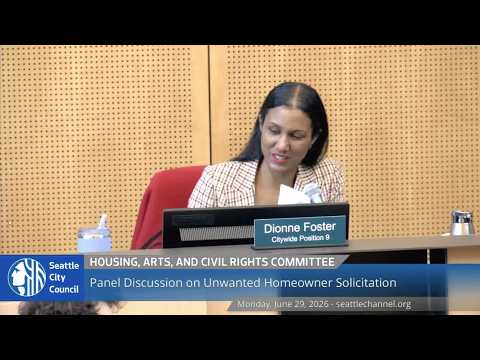
Seattle committee reviews ‘Do Not Solicit’ proposal to curb predatory homebuying outreach
Summary
The Housing, Arts & Civil Rights Committee reviewed draft legislation to create an opt‑in Do Not Solicit list and prohibit unwanted residential solicitations, with Office of Civil Rights enforcement, monetary penalties, and outreach concerns raised by councilmembers and community groups.
Seattle council staff on June 29 outlined a draft ordinance that would prohibit unwanted solicitation of residential properties and establish an opt‑in Do Not Solicit registry administered by the Office of Civil Rights (OCR).
The ordinance, as presented by Jennifer Labrecque, central staff analyst, would add a definition to Seattle Municipal Code Section 14.08.020 and make unsolicited attempts to purchase or otherwise acquire an interest in a home an unfair housing practice. Labrecque said the plan would allow homeowners who have received at least one unsolicited solicitation to add their address to a public Do Not Solicit list and be protected from further outreach. "The legislation would establish a new unfair housing practice, prohibiting unwanted solicitation of residential properties, and simultaneously establish a Do Not Solicit list, which homeowners could opt to add themselves to," Labrecque said.
Why it matters: Council members and community witnesses said solicitations — often by call centers, mass mailings or aggressive in‑person visits — are harming long‑term and legacy homeowners and can contribute to displacement. The draft would create civil penalties, which Labrecque described in committee as including $11,000 for a first violation and $2,000 for subsequent violations within a 12‑month period; committee members asked staff to confirm the precise penalty language and whether the clock resets after 12 months.
Key provisions and implementation: Labrecque told the committee the ordinance would: (1) define solicitation to include phone, mail and electronic outreach that attempts to purchase or acquire an interest in residential property; (2) create a publicly maintained opt‑in Do Not Solicit list; (3) require OCR to administer the registry and enforce the prohibition (including a private right of action); and (4) allow OCR six months to build systems and outreach before the registry opens — targeting a June 1, 2027 start. Estimated implementation costs were presented as $200,000 in 2027 and $375,000 in 2028, primarily to staff OCR positions.
Council questions and concerns: Lawmakers repeatedly pressed staff on outreach and enforcement capacity. Councilmember Lin asked, "How are we thinking about partnering with organizations or partnering with communities to make sure folks know about this opportunity?" Labrecque said OCR envisions partnering with the Department of Neighborhoods and the Office of Housing and that the engagement specialist role is intended to do community outreach.
Members also raised enforcement challenges: identifying wholesalers and call centers, multilingual outreach, and the risk the ordinance's definition of "solicit" could unintentionally restrict legitimate communications (for example, government programs, lenders or community service providers). Labrecque said the definition was added specifically to the fair housing section of the code and staff would consult the city attorney for clarification on fines and scope.
Next steps: The item was informational; staff said the ordinance is scheduled for formal introduction at committee on July 8 with amendment concept deadlines. Councilmembers asked for follow‑up briefings on implementation plans and outreach strategies.
Closing note: Committee members and staff agreed the policy will require iterative refinement after implementation to close loopholes, shore up outreach to seniors and immigrant communities, and ensure enforcement resources are adequate.