Get Full Government Meeting Transcripts, Videos, & Alerts Forever!
Get email alerts on the Social Services topic
No spam. Unsubscribe anytime.
Burke County DSS presents 2025 annual report: Medicaid caseload, SNAP disbursements and rising foster care numbers
Summary
Department of Social Services Director Corey Fisher Wellman told commissioners in a detailed 2025 annual report that roughly 28,000 Burke County residents received Medicaid in 2025, the county distributed about $21 million in food nutrition benefits, and 308 children experienced foster care; commissioners voted 4‑0 to accept the report.
Burke County's Department of Social Services presented its 2025 annual report on April 6, detailing caseloads, program spending and recent system transitions. DSS Director Corey Fisher Wellman said the agency ended 2025 with approximately 28,000 people receiving Medicaid and distributed just over $21 million in food nutrition benefits in the county during the year.
Why it matters: The report outlines service volumes that inform county budgeting and state reimbursement, and it highlights increases in child welfare caseloads that county staff linked to a prior CPS backlog and policy changes. Director Wellman said the department handled point‑in‑time pressures while implementing statewide system changes, including a transition to Healthy Blue for foster care services and a new child welfare data system.
Key numbers and program notes: Corey Fisher Wellman reported roughly 28,000 Medicaid recipients in Burke County at year‑end 2025 and about 21 million dollars in food nutrition (SNAP) payments. DSS staff said they processed roughly 400 Medicaid applications per month and completed 8,567 Medicaid transportation trips in 2025. The department reported 308 children experienced foster care in 2025 (126 entered custody, 105 exited), and completed 37 calendar‑year adoptions; fiscal adoption incentives were noted for surpassing state baselines.
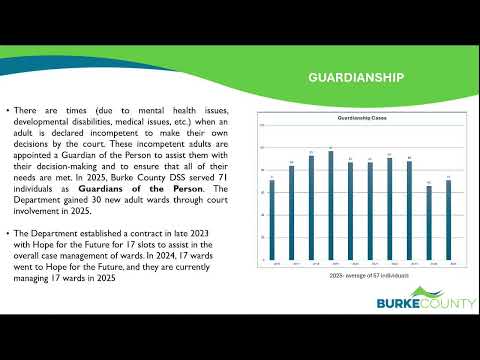
Wellman summarized the report: "We try to do this in March or April of each year," and highlighted the staffing and program work that produced the numbers commissioners reviewed. DSS staff also reviewed other programs including TANF/workfirst caseloads, energy assistance volumes, child care subsidy allocations (about $3 million serving 432 children), adult protective services investigations and guardianship caseloads.
Outcome: A motion to accept the 2025 DSS annual report passed by voice vote, 4‑0. Commissioners and staff noted continued attention to foster care trends, system transitions and reimbursement mechanics.