Get Full Government Meeting Transcripts, Videos, & Alerts Forever!
Get email alerts on the Short Term Rentals topic
No spam. Unsubscribe anytime.
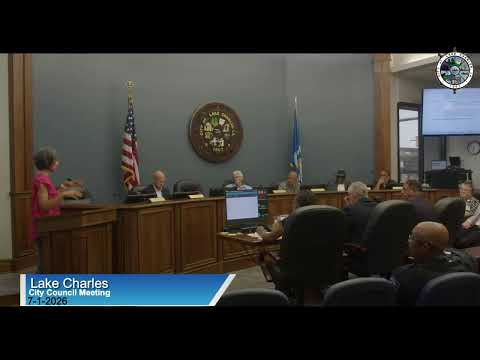
Council grants variance for short-term rental at June Street, agrees to revisit 1,000-foot rule in mixed-use areas
Summary
After an appeal of a planning-commission denial, Lake Charles City Council voted to grant a variance for a short-term rental at 3121–3123 June Street and instructed staff to explore amnesty provisions and possible ordinance amendments to address mixed-use areas.
The Lake Charles City Council voted to grant a variance that will allow a short-term rental to operate at 3121 and 3123 June Street despite a recently adopted city rule barring new short-term rentals within 1,000 feet of an existing licensed short-term rental.
Planning staff opened the hearing by explaining the commission’s denial on the grounds the proposed unit sits within 1,000 feet of a lawfully registered short-term rental. The city adopted the 1,000-foot limit several months earlier to reduce clustering of short-term rentals in neighborhoods, staff said.
Applicant-support testimony described the property as a duplex with parking for “seven or eight” cars and said the unit has been listed on Airbnb since Aug. 16, 2022. A resident who spoke in support, Chad Carroll (1320 L Street, Sulfur), confirmed the property’s proximity to a commercial area and said parking and circulation should accommodate the use.
Planning and legal staff told council they are developing two separate responses: (1) an amnesty program to document previously operating short‑term rentals that have been collecting occupancy taxes and (2) a review of whether the 1,000‑foot rule should be refined or exceptions created for mixed‑use or commercial districts. "We are looking at an amnesty program," staff said, "since a lot of these short‑term rentals were already operating, but they weren't required to be registered." (Mr. Bigas)
Several council members said the ordinance’s original intent was to protect residential neighborhoods, not to unduly restrict mixed‑use commercial areas. After deliberation, a motion to grant the variance carried.
The council instructed planning staff to draft language for an amendment that could create distinctions for mixed‑use or commercial zones, and to return that language to council for consideration. The council did not take any action at this meeting to change the overall 1,000‑foot rule; instead, members directed staff to prepare possible exceptions and to develop the amnesty process.
Next steps: planning staff will prepare proposed ordinance amendments and details on the amnesty program; council members said they expect that work to return for review at a forthcoming meeting.