Get Full Government Meeting Transcripts, Videos, & Alerts Forever!
Get email alerts on the Education Funding topic
No spam. Unsubscribe anytime.
Guilford officials say special education costs and state reimbursements shaped this year’s surplus
Summary
Officials told residents special-education spending is volatile and that higher-than-expected state reimbursements and fewer outplacements produced a surplus; they gave sample tuition invoices and described how surpluses will be allocated.
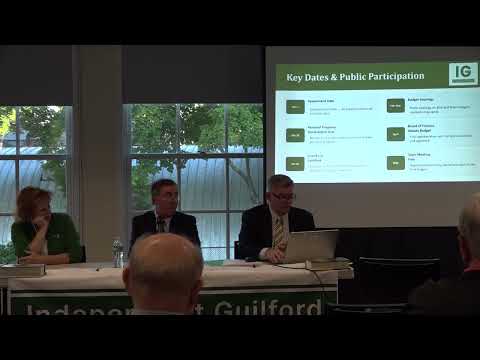
Guilford board members and school officials told a public forum that special education is one of the most volatile drivers of the school budget and that recent changes in outplacement counts and state reimbursements explain this year’s surplus.
Jennifer Baldwin, a board of education representative, said the district has worked to keep more students in-district to reduce costly outplacement tuition, but noted that in-district support requires contracted specialists and transportation. Baldwin and other presenters offered concrete examples of outplacement tuition invoices, reading monthly amounts aloud such as $12,400 and $8,900 and noting some single-month invoices as high as $27,000.
Panelists described the state’s ‘excess cost’ recapture policy—where the state in theory reimburses the town for amounts above an average per-pupil baseline—and said that reimbursement rates have historically fallen short of the statutory intent. The presenters said Guilford recently received around 68% of those excess costs in the referenced year, higher than the more common 60–65% range, and that the better-than-expected reimbursement contributed to an end-of-year surplus.
Numbers discussed: panelists said the proposed FY 2026–27 special-education tuition budget was in the roughly $3.6–3.7 million range (transcript figures were spoken and partially garbled; the presenters described a multi-million-dollar tuition line), and special-education transportation was described roughly as $1.8 million. The presenters stressed these are large, often one-time or unpredictable costs and that some savings this year came from fewer outplacements and higher reimbursements rather than structural savings.
How surplus money will be used: officials explained that surplus funds are used line-by-line to cover over-budget items, to repay medical reserves, and to seed a state-authorized non-lapsing education fund intended for one-time education-related expenditures (not to fund recurring positions). The board emphasized that one-time fund uses are appropriate for capital or emergency needs but not for ongoing staffing costs.
Officials encouraged residents to examine monthly warrants and the public warrants for detailed vendor and tuition listings and to bring questions to the October and fall budget input sessions.