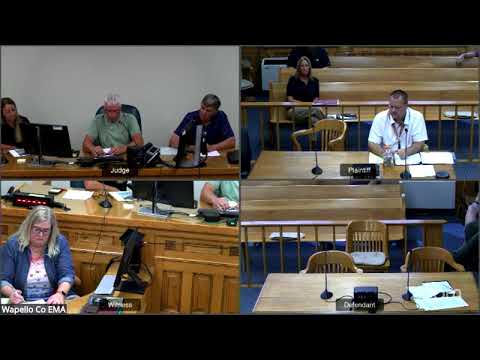
Supervisors discuss data center development, exemptions and tax implications; no moratorium set
Summary
Wapello County supervisors discussed whether to study or adopt a moratorium on data center development, focusing on community engagement, facility sizing, and how new-construction value and industrial exemptions could shift taxes to other taxpayers; supervisors asked for further research and ordinance models from peer counties.
Members of the public and several supervisors discussed potential data center development in Wapello County and whether the county should adopt a moratorium or ordinance to study and regulate such projects.
A resident asked where the county stood after a prior briefing and whether the county had pursued a moratorium similar to actions taken in other Iowa counties. Supervisors and staff said the topic needs more research; staff noted several nearby counties (Jefferson, Mahaska, Lynn and Monroe) have considered ordinances or temporary moratoria and that Lynn County’s ordinance is viewed as comprehensive on setbacks and wastewater provisions.
County staff and supervisors focused on several practical questions: appropriate facility sizing and setbacks, community engagement to gauge public sentiment, electrical and water utility demands, and how the state’s new property tax treatment would treat data centers. A county assessor’s representative explained that data centers would be treated as new construction for budgeting purposes; if an industrial or other tax exemption were granted, the full new-construction value could still be realized for budget increase calculations even if the facility paid reduced taxes, which would distribute costs across other taxpayers until exemptions expired.
Supervisors said they will gather ordinance examples, consult technical stakeholders, and continue fact-finding; no moratorium or ordinance was adopted at the meeting. The board scheduled additional informational conversations and encouraged staff to provide draft ordinance language and comparative studies for future consideration.
AI generated
The text on this page is AI generated. Summaries, highlights, analysis, and video transcripts are all produced from the original source material.
AI can make mistakes, so if you spot one, and we will fix it for everyone.
Note: the source content is unaltered by us. Any content source we link to, be it a video, an audio recording, or a document, is presented exactly as its publisher released it. That publisher is usually a government body, sometimes an individual official or another organisation.