Get Full Government Meeting Transcripts, Videos, & Alerts Forever!
Get email alerts on the Ai Copyright topic
No spam. Unsubscribe anytime.
House Judiciary Committee member warns AI training on copyrighted works underscores need for updated rules
Summary
Mr. Raskin told the House Judiciary Committee that three of his books were used to train Anthropic’s Claude and that a judge found the ingestion qualified as fair use, saying the episode highlights gaps in copyright law and urging Congress to protect creators while enabling safe AI innovation.
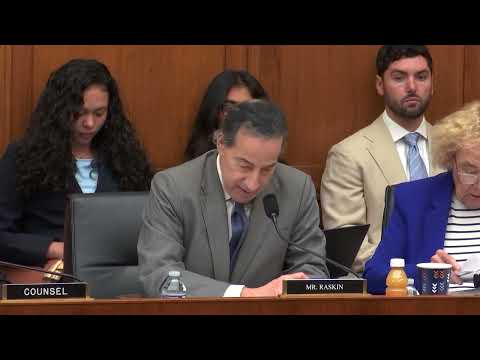
Mr. Raskin, a member of the full committee, opened the hearing by recounting that he recently received a postcard notifying him that three books he wrote had been used to train Anthropic’s Claude and that he was included in a settlement in a case he described as Barthes v. Anthropic. "A judge found Anthropic ingestion and digestion of my books without payment was fair use," he said.
Raskin framed his anecdote as symptomatic of a broader problem: current intellectual property law did not anticipate the scale or speed of generative AI. He warned that, even if a model cannot legally reprint a book "line for line and sell it," the model may still "profit off of my word choice, my cadence, my style, my conceptualizations and my research" without compensating creators.
The congressman urged the committee to treat such cases as more than isolated incidents, arguing that AI companies "intentionally select works with which to train their large language models, often with zero intention of paying the creators any royalties" and that these legal outcomes reflect "proliferating tensions between existing law and social values" in an era of rapid technological change.
Putting AI in historical context, Raskin contrasted today’s issues with the legal landscape when the Digital Millennium Copyright Act (DMCA) was written nearly 30 years ago, noting that lawmakers did not foresee streaming platforms, automated ingestion of large corpora, or the speed with which infringing material can reappear online. He warned that consumer harms have expanded beyond media piracy to dangerous counterfeit goods sold online, and cited industry-scale figures, saying the issues "affect not just the 2 million employees of the movie industry, or the nearly $12 billion in revenue from the music industry, but also the consumers who end up paying the cost of counterfeit goods."
Raskin said there are proposals on the table to adapt compensation models for creators, and he identified himself as a co-sponsor of the American Music Fairness Act, which he said "would ensure that performers are paid when their music is actually played on the radio." He added that generative AI ‘‘is supercharged’’ and that longstanding problems have been amplified by current technologies.
On preemption, Raskin warned against broad federal preemption of state common-law causes of action and state legislative decision-making, saying there is no reason to "do away with common law tort claims that act as the basic national safety net for fairness." He advocated allowing the National Institute of Standards and Technology (NIST) to test frontier models and urged Congress to seek policy that both preserves creator incentives and enables states to experiment with solutions.
Raskin concluded by asking the committee to consider how to "map a path forward for all Americans to use technology while ensuring laws that protect consumers ... artists, writers and inventors" and to think long term so that creative labor can be sustained as generative AI develops. The hearing proceeded as an opening statement and did not record a formal vote or motion on policy during these remarks.