Get Full Government Meeting Transcripts, Videos, & Alerts Forever!
Get email alerts on the Land Development Fire Code topic
No spam. Unsubscribe anytime.
Council approves RV restrictions and raises hydrant distance; fire chief says modern tactics mitigate risk
Summary
The council unanimously approved amendments to land-development rules covering recreational vehicle (RV) occupancy and an increase in allowable hydrant distance. A local fire chief, speaking in his official capacity, backed the hydrant-distance change, citing mutual aid and modern hoses.
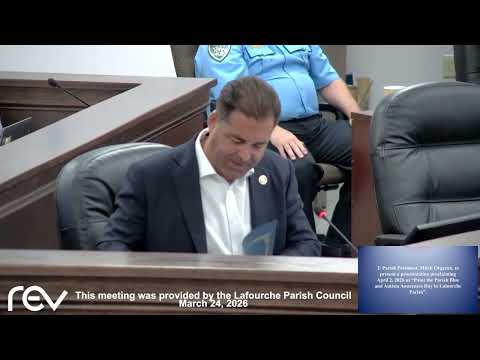
The Lafush Parish Council on March 24 approved an ordinance amending Chapter 22 of the parish code governing land development, including restrictions on long-term RV occupancy and a fire-hydrant-distance change that expands the allowable distance to roughly 1,000 feet.
A fire chief, who identified himself during the discussion, told the council that modern firefighting equipment and mutual-aid practices make the proposed hydrant-distance increase defensible. “We will find water and we will get water to a scene,” he said, adding that contemporary pumpers and large-diameter hose (LDH) allow crews to achieve an initial knockdown even when hydrants are farther apart.
Vice Chair Perk and other council members discussed enforcement questions, liability and how the ordinance shifts responsibility for noncompliant RVs. Perk noted the ordinance “does release the liability on the parish” when private property owners fail to meet standards. Parish President Mitch Oro said the change had been vetted with legal advisors and staff and thanked the staff (Diana Leant and Tony Bro were named in the transcript) for preparing the ordinance.
The council voted 9–0 to approve the ordinance. Supporters argued the change balances public-safety needs with development cost realities (for example, the cost of installing private hydrants), while opponents raised enforcement concerns and the practical upkeep of levees and infrastructure when district services are consolidated.
Next steps: administration will execute the ordinance and continue to refine enforcement procedures and public communication about permitted RV occupancy and hydrant requirements.