Get email alerts on the Infrastructure Data Centers topic
No spam. Unsubscribe anytime.
Polk County hears groundwater briefing, adopts resolution and draft permit policy aimed at data center impacts
Summary
After a detailed briefing from the Lower Trinity Groundwater Conservation District on aquifer health and water use, Polk County Commissioners approved a resolution calling for transparency and independent impact studies for large data centers and advanced a draft site-impact permit policy that would require engineering disclosures for high-load facilities.
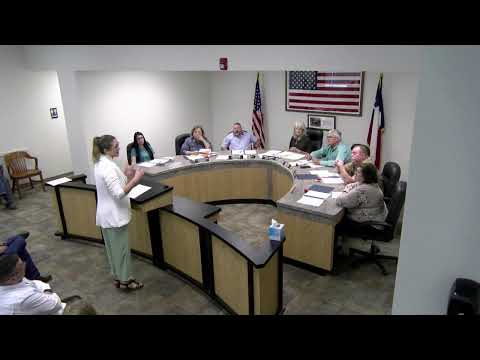
Polk County Commissioners on March 24 heard an extended briefing from the Lower Trinity Groundwater Conservation District about local aquifer conditions and voted to approve a resolution asking the state for greater county authority and transparency around data-center development. The court also reviewed and advanced a draft site-impact permit policy and fee schedule aimed at industrial high-load facilities, including data centers.
The meeting featured a technical presentation by Gary of the Lower Trinity Groundwater Conservation District, who framed Polk and neighboring San Jacinto counties as sitting on a shallow outcrop of the Gulf Coast Aquifer and described recent rises in local pumping. "Ten years ago we were pumping in the district between Polk County and San Jacinto County about 3.3 million gallons of water a year. Up to this year at the end of 2025, we were pumping 4 and 1/2 million gallons of water per year," Gary said. He told the court the district charges commercial water users roughly 4 cents for every 1,000 gallons and that private residential wells are tracked but not charged; district counts moved from about 5,000 private wells to roughly 7,400 over the last decade.
Gary warned that while Polk County benefits from a faster-recharging portion of the Gulf Coast Aquifer, the region could become a target for export if demand elsewhere rises. He cited examples of large data centers and private water-permitting proposals in other parts of Texas and said he was tracking subsidence and planned to add monitoring stations in Polk and San Jacinto counties to detect land movement.
In response to local concerns raised during the briefing, the court unanimously approved a resolution that recognizes both the economic role of digital infrastructure and the need for safeguards. The resolution calls for:
- increased transparency in reporting electricity demand and water usage by prospective industrial high-load facilities; - independent impact analyses before project approvals; - adoption of water-efficient and other sustainable development standards; and - legislative changes to give counties greater authority and cost-participation mechanisms when large projects affect local infrastructure.
County staff also presented a draft industrial high-load facility site-impact permit policy and fee schedule that would apply to projects meeting one or more thresholds: applications drawing 1 megawatt or more of electrical demand, continuous 24/7 industrial operations, large-scale cooling systems, on-site power generation, or containerized outdoor equipment. The draft requires sealed engineering documentation covering electrical load, cooling and water usage, noise, traffic, road impacts and stormwater management; reviews would involve the fire marshal, the county engineer, the flood-plain administrator, emergency management and applicable commissioners. Legal counsel recommended a public hearing before final adoption, and the court agreed to advance the draft for public review.
Commissioners emphasized the county must work within state law while seeking additional tools from the Legislature. The resolution and draft policy are intended to ensure county officials have timely, project-specific data to assess grid reliability, water availability and infrastructure impacts before construction begins. County staff said existing lawful facilities would be grandfathered unless they expand to meet the policy’s thresholds.
The court’s actions create a formal record the county can share with state legislators and utility providers, and they direct staff to prepare public hearing materials and additional legal review before a final vote.