Get Full Government Meeting Transcripts, Videos, & Alerts Forever!
Get email alerts on the Personnel Costs topic
No spam. Unsubscribe anytime.
County committee weighs 0% vs. 2% COLA and how to phase out longevity payments
Summary
Council guidance recommended a 0% COLA, but staff and consultants told the committee a 2% COLA is affordable under current projections; members debated how step increases and longevity phase‑outs would change long‑term costs and reviewed two phase‑out scenarios for longevity.
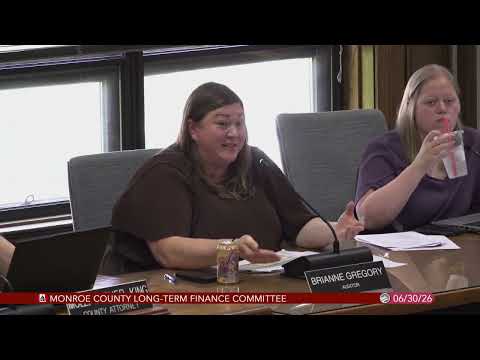
Monroe County's long-term finance committee spent a large portion of its June 30 meeting on personnel-cost choices for FY2027, debating whether to recommend a 0% or 2% cost-of-living adjustment and how to address the county's longevity supplement.
The Council President's letter circulated to department heads recommended a 0% COLA, but auditor and consultant presentations showed a 2% COLA is affordable in the short term. Brienne Gregory summarized packet estimates and staff corrected prior calculation errors; she told the committee that staff and consultants were refining the inputs. Greg Geratas of Financial Solutions Group reiterated that the sustainability model used a 2% COLA assumption.
Members pressed staff on how step increases interact with COLA. Staff noted that "step increases" are separate from COLA and that many employees receive step increases in any given year; the auditor's snapshot suggested the aggregate effect of step increases across the workforce could be substantial. Committee and consultant discussion flagged that step increases plus COLA can produce materially higher recurring costs than a flat COLA assumption alone.
The committee also discussed longevity, a separate supplemental payment currently paid to many long‑service employees. Staff presented two phase-out options: a shorter two‑year phase‑out (50% reduction in 2027, zero in 2028) and a four‑year phase‑out (25% in 2027, 50% in 2028, 75% in 2029, zero in 2030). At the packet snapshot, staff said 433 employees were receiving longevity and the current program's fiscal impact was described as a mid-hundred-thousand-dollar figure for the year; staff recommended council consider the two structured phase-out options or leave the current attrition‑based approach in place.
Committee members emphasized the need for accurate, per‑employee data before final recommendations. The consultant asked staff to quantify how many of the county's roughly 629 employees would receive step increases in a given year so the council could better assess the combined cost of steps plus any blanket COLA and how that differs from the sustainability model assumption.
Next steps: staff will return with a clearer breakdown of how many employees would receive step increases, exact per‑employee impacts, and reconciled cost figures to inform the council's budget instructions.