Get Full Government Meeting Transcripts, Videos, & Alerts Forever!
Get email alerts on the Service Territory topic
No spam. Unsubscribe anytime.
Brainerd BPU to negotiate service-territory swaps with neighboring utility over Hwy 371 project
Summary
Brainerd Public Utilities authorized staff to negotiate adjustments to service-territory boundaries with a neighboring utility to accommodate expected infrastructure impacts from the Highway 371 project; staff estimated relocation costs of roughly $268,000 but noted a long payback under existing margins.
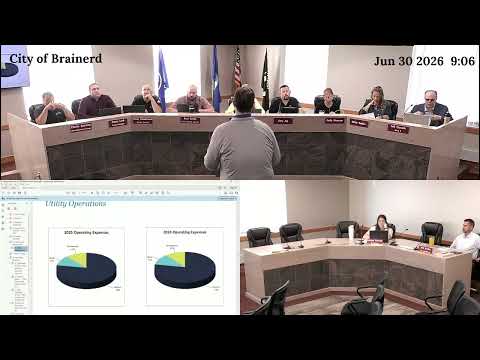
Brainerd Public Utilities Commissioners authorized staff on June 30 to continue negotiations with an adjacent electric provider (referred to in the meeting as Growing Power) to clean up service-territory boundaries affected by the Highway 371 project in Baxter.
Electric operations staff described how the 371 project will remove commercial parcels and require relocations or reconfigurations of distribution infrastructure near the city boundary. Staff estimated direct relocation and project-related costs at about $268,000. Trent, the utility’s electric director, said the work would consume scarce margin dollars: at current margins the payback period on that cost would be extremely long.
"From a financial perspective, it looks better to give up customers," Danny said, noting that some customers that are currently served across the boundary produce minimal revenue relative to the capital required to serve them.
Staff recommended a pragmatic, holistic trade: negotiate boundary lines so each utility serves contiguous territory (using Highway 371 as a clean demarcation) and arrange for the neighboring provider to perform relocation legwork and hold the PUC filings where needed. Commissioners discussed operational benefits (clearer outage responsibility, faster emergency response) and long payback periods; the Commission approved continuing negotiations with limitations that any actions outside the discussed scope would return to the commission.
Why it matters: service-territory clarity affects who responds to outages, who pays for infrastructure relocations and where future load-growth revenue accrues. Commissioners asked staff to seek negotiated arrangements that minimize Brainerd’s near-term capital exposure while cleaning up long-term boundary complexity.