Get Full Government Meeting Transcripts, Videos, & Alerts Forever!
Get email alerts on the 216 Greenfield Data Center topic
No spam. Unsubscribe anytime.
Planning commission gives conditional approval to 216 Greenfield Road data center; residents press zoning and environmental concerns
Summary
By a conditional vote, the Lancaster City Planning Commission moved the preliminary plan for redevelopment at 216 Greenfield Road forward subject to a developer agreement requiring applicants to satisfy outstanding review comments; public commenters raised questions about whether data centers should be classified as warehouses, water use, jobs, greenhouse impacts and process transparency.
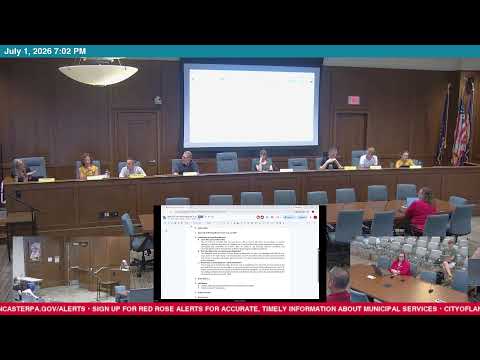
The Lancaster City Planning Commission on July 1 conditionally approved the preliminary plan for a large redevelopment at 216 Greenfield Road that would repurpose portions of the former Donnelly printing site and construct data center buildings, while also approving a waiver to allow remaining technical conditions to be addressed under a preliminary developer agreement.
Cheryl Love of LA Group and Jeff Sterler, representing the project team, described the proposal and the technical steps remaining. Sterler told the commission the plan increases green space on the city portion of the site by about nine acres, adds roughly 383 trees across the property and provides 117 bicycle spaces. The applicant said it is providing 15,000 square feet of green roof and intends to replace portions of aged sewer pipe and improve stormwater outfalls; conservation district review and an MPDES permit were expected in the coming weeks.
"We're providing quite significant improvements to the property itself," Sterler said, citing tree plantings, green roof area and stormwater improvements.
Commissioners questioned water use and cooling systems. Applicant representatives said the site holds an allotment of up to 20,000 gallons per day of water related to building occupant needs and dehumidification. The applicants said cooling is a closed‑loop liquid system that recycles water and does not use glycol; they estimated each building’s dehumidification could peak at about 7,000 gallons on hot days. "So most of it's going to be used for dehumidification," an applicant said.
Public comment was extensive and at times contentious. Several residents, including Frank Archolio and Tony Dasher, urged the commission to defer or refer zoning questions to the Zoning Hearing Board, arguing that prior advisory communications and a February 18, 2025 letter from the zoning officer created confusion about whether data centers qualify as warehouses under current code. Frank Archolio said he had filed an appeal that was not heard and described a court ruling characterizing the February letter as an advisory opinion rather than an official zoning determination.
"You are being asked to approve a site development plan and as such you must also approve the zoning classification," Archolio said, urging the commission to seek a formal determination from the Zoning Hearing Board before action. Other public commenters raised environmental concerns, potential impacts on wildlife and pollinators, employment expectations (applicants said 146 full‑time employees across both buildings), emergency access arrangements and the possibility of using solar to offset energy use.
Staff recommended conditional approval with a preliminary developer agreement that requires the applicant to satisfy all outstanding review comments listed in the latest review letter prior to final plan recording. Commissioners approved that conditional motion and then approved a waiver to allow the applicant to address those items through the preliminary developer agreement rather than meet every technical detail before conditional approval.
Commissioners and staff emphasized that the commission's role is to apply the SDO/Saldo and the project's compliance with ordinances; several commissioners expressed empathy for resident concerns about process and requested that staff ensure the developer agreement and final plan address outstanding issues raised in public comment.
Next steps: the applicant must satisfy outstanding review comments, finalize required agreements, and return for final plan approval. Residents who raised zoning and process concerns retain appeal rights under the city's procedures and may seek determinations from the Zoning Hearing Board if they believe a formal zoning interpretation is needed.