Get Full Government Meeting Transcripts, Videos, & Alerts Forever!
Get email alerts on the Housing Cap topic
No spam. Unsubscribe anytime.
County supervisor and planners seek community input to avoid forced 50% coastal cap increase after Cypress Point approvals
Summary
County staff told Midcoast residents that December approvals, including a 71‑unit affordable project, pushed the area past its 40‑unit annual coastal cap and presented six amendment options—ranging from banking unused allotments to short‑term averaging—asking the public to prioritize which avoids an automatic 50% cap increase and long delays for permit applicants.
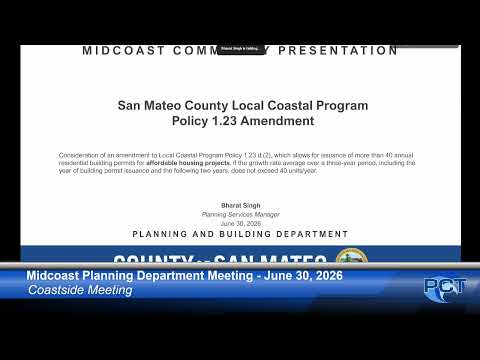
Supervisor Mueller opened the meeting saying staff wanted community input on how to respond after approvals pushed the Midcoast past its long‑standing 40‑unit annual coastal growth cap, and urged participants to choose whether the county should leave the cap as written, pursue a banked‑credits approach, or seek temporary averaging to reduce a looming backlog.
Steve Mings, director of the Planning and Building Department, disputed a news item that reported the county proposed raising the cap to 75 units, calling that story inaccurate. He apologized for getting ahead of outreach and said staff’s goal is to protect neighbors who have already invested money and time in permits while avoiding actions that would permanently raise the cap unless necessary.
Planning staff presented six alternatives and explained the tradeoffs. Camille Leo, a planner, described an interim wait‑list system that would prioritize building permits by ‘‘permit readiness’’ (the date reviewers sign off) so projects already in the pipeline could keep their place when the county reopens building permit intake. Staff said the county paused accepting new building permits to avoid compounding the 2025 exceedance and to limit the risk of a cascading backlog through 2028.
Staff said Cypress Point’s approvals in late 2025 produced a total of 102 units for that year, creating an excess above the 40‑unit target that must be accommodated across the housing‑element period. Under Housing policy 11.6 and the county’s Local Coastal Program (LCP) rules, if the cap is exceeded the county may need to go to the California Coastal Commission with an amendment that would raise the local limit by at least 50%—from 40 to roughly 60 units—unless the county adopts a different local approach first.
The six alternatives ranged from ‘‘no change’’ (continue the wait‑list and accept a future request to the Coastal Commission) to forward‑looking averaging triggers that temporarily increase allowable issuance for two years, to backward‑looking ‘‘banking’’ options that count unused allotments from prior years. One banking variant would look back to 2013 and apply roughly 166 unused allotments staff identified; a narrower variant would use a rolling 10‑year lookback. Staff said the Coastal Commission had viewed a banking approach in principle and that the planning commission had considered a similar variant.
In lengthy public Q&A, residents raised two recurring concerns: (1) fairness and prioritization for homeowners who had already paid fees and were ready to build, and (2) infrastructure and safety — wastewater overflows, traffic and wildfire evacuation routes. One resident said the cancellation of previously active permits had been ‘‘cruel’’ and asked whether those inactive permits could be reinstated; staff replied they intended to ‘‘bring those back to life’’ once an approach is chosen and that planning approvals already in place would preserve a project’s entitlement.
On infrastructure, staff acknowledged constraints and said that fire marshals and county emergency management are engaged. The county said improving roads and other systems would likely increase the allowable growth cap under the state’s rules, which is why the current cap reflects existing infrastructure limits.
Supervisor Mueller said his priority is a path that avoids triggering the automatic 50% increase, favoring options that quickly return annual issuance toward historical averages. Staff closed by asking attendees to register one preferred alternative through an on‑site QR‑code survey; results will be summarized for the Midcoast Community Council and the Board of Supervisors and used to shape a formal recommendation to regional authorities.
The county did not take a formal vote at the meeting; the next steps are analysis of the community survey, potential drafting of a short LCP amendment for the board, and coordination with the Coastal Commission if an amendment route is chosen.