Get Full Government Meeting Transcripts, Videos, & Alerts Forever!
Get email alerts on the Petroleum Site Characterization topic
No spam. Unsubscribe anytime.
MassDEP to seek public comment on updated petroleum site characterization guidance
Summary
MassDEP staff said they will post a new draft "petroleum site characterization guidance" (an update to the 2002 VPH/EPH approach) for a 60‑day public comment period, adding technical sections on ruling out non‑petroleum contaminants, homeowner spills, sampling methods and imminent‑hazard metrics.
Massachusetts Department of Environmental Protection staff said they will post a draft update to petroleum site characterization guidance and open a 60‑day public comment period.
Acting division director Brian Roden told attendees the department intends to post the draft "petroleum site characterization guidance"—a revamp of the 2002 VPH/EPH approach—targeting next Monday and to publish a link and email notice to stakeholders. "It's a big document. There's a lot in there, and very technical, so give people some time to wade through it," Roden said.
John Fitzgerald, who led the technical presentation, said the update adds roughly 20 pages to incorporate regulatory and technical changes since 2002. Key additions include expanded guidance on screening to reduce unnecessary analytical testing outside groundwater‑one areas; new, lower‑cost vapor‑intrusion screening options; stronger emphasis on ruling out non‑petroleum VOCs (for example, CVOCs) where those contaminants are likely; and new homeowner‑specific guidance intended to avoid expensive responses such as underpinning or full excavation when not required under the MCP.
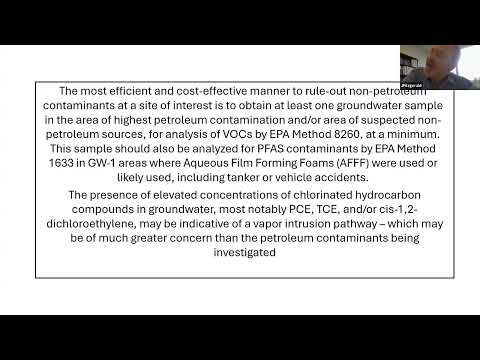
Fitzgerald described specific sampling recommendations: at least one groundwater sample in the area of highest petroleum contamination analyzed for VOCs by EPA method 8260 or VPH by GC‑MS to help rule out non‑petroleum sources. He also said PFAS testing (EPA method 1633) may be warranted in certain large tanker‑spill scenarios involving foam and only in groundwater‑one areas.
On regulatory thresholds, Fitzgerald explained changes to how imminent‑hazard metrics are expressed, saying values should be reported to one significant figure and that the criterion is treated as "equal to or greater than" when assessing whether a value constitutes an imminent hazard. (The transcript alternately referenced different years for that MCP change; MassDEP should clarify the effective date in the public materials.)
Fitzgerald emphasized the statutory framework under Mass. Gen. Law chapter 21E and the Massachusetts Contingency Plan (MCP), noting that release tracking numbers (RTNs) can be consolidated and that site closure applies to disposal sites or portions thereof only after all MCP‑regulated contaminants meet required endpoints, regardless of who has liability.
The draft also expands discussion of active and passive mitigation systems (SSD systems) as an approach to reduce exposures and accelerate biodegradation. Fitzgerald said such systems can help achieve a no‑significant‑risk condition but cautioned that long‑term operation by potentially liable parties may not be feasible; homeowners could elect to operate systems post‑closure.
Roden confirmed the department expects a 60‑day comment window and said staff will post the draft on the MassDEP website and circulate an email notice. He said the department hopes to collect technical feedback and asked reviewers to "keep us honest" about details in the draft.
Next steps: MassDEP will post the draft and publish comment instructions; stakeholders asked that the department clarify timelines and any specific formatting needs for submitted materials when the posting is announced.