Get Full Government Meeting Transcripts, Videos, & Alerts Forever!
Get email alerts on the Fire Department Budget topic
No spam. Unsubscribe anytime.
Douglas County weighs up to 4.1‑mill levy to fund 10 positions for Consolidated Fire District 1
Summary
County staff presented three staffing options for Consolidated Fire District No. 1 that would add between six and 10 full‑time positions to address volunteer shortfalls and long response times; commissioners set a July 10 follow‑up and no vote was taken at the July 1 work session.
Douglas County staff and Consolidated Fire District No. 1 leaders told the Board of County Commissioners on July 1 that the district’s volunteer response has fallen dramatically and that a supplemental budget request could add up to 10 full‑time employees, a change staff said could require up to a 4.1‑mill increase in the district’s levy.
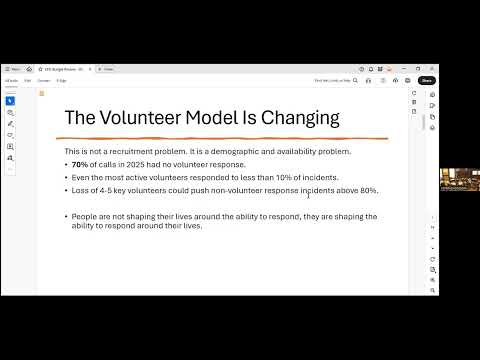
Sean, a county staff presenter, said the district covers roughly 230 square miles, includes the city of La Compton and operates 10 stations with 38 pieces of apparatus. He said the district is currently staffed with six full‑time firefighters (two per 24‑hour shift), two chiefs, one administrator and about 45 volunteers. “Based off of last year’s data, 70% of the calls … had no volunteer response,” Sean said, citing the district’s 2025 call data.
The district and county described operational effects from that decline: longer response times, overlapping calls that stretch coverage across long travel distances, and portions of the district where a single responder may be the only staffed person at a station. Department leadership said added staffing has already reduced response times in parts of the district where recent hires were deployed.
To address that situation, staff laid out three budget options. Option A would add six full‑time firefighters, three captains and one battalion chief (a total of 10 new FTEs); Option B would add the firefighters and captains but defer the chief; Option C would add only six firefighters. Staff presented Option A as producing the broadest operational and programmatic benefits but also the largest levy impact, described in the packet as up to about a 4.1‑mill increase for the district.
The county and the district discussed practical recruitment and onboarding challenges. The chiefs and staff said hiring full‑time firefighters is difficult in the current labor market and that the district prefers applicants with existing training or recruits who can be rapidly brought up to required competency. Staff proposed phasing hires so that firefighters arrive first and leadership positions could be promoted from internal candidates or filled externally, a process staff estimated could take roughly four to six months from hire to operational readiness.
Commissioners and staff also discussed how additional personnel would enable two‑person working companies, expanded training time, more plan review and public‑education work, and improved ability to pursue grants. Staff reviewed federal grant programs including the Staffing for Adequate Fire and Emergency Response (SAFER) awards and Assistance to Firefighters/AFG grants. Sean and the chiefs cautioned that staffing grants typically require the local jurisdiction to commit to covering positions after federal support phases down.
Commissioners reported that the city of La Compton submitted a letter of support for additional staffing (the city council’s action was described as unanimous), and staff said outreach to townships in the district had not generated negative reactions to the request so far. County staff and commissioners noted the district’s non‑residential tax base includes large taxpayers such as Barry Plastics and the Lawrence Energy Center; a commissioner also reported Douglas County received $72,000 in federal PILT payments for 2026 but staff said those funds are distributed to schools and townships and do not directly fund rural fire districts.
No formal motion or vote occurred at the work session. Commissioners asked staff to refine figures and return for further budget deliberations; staff requested direction or refined materials for the July 10 budget discussion and noted the revenue‑neutral rate resolution is scheduled for July 15, with the final levy vote later in the public budget process.
What happens next: county staff will provide refined levy and budget impact estimates and further outreach materials in advance of the July 10 follow‑up meeting. If the commission elects to pursue a revenue change, public hearings and the statutory revenue‑neutral process will follow before any levy is adopted.
Attribution: Quotations and specific data in this article come from county staff and Consolidated Fire District No. 1 leadership at the July 1, 2026 Douglas County Board work session. No formal action was taken during that session.