Get Full Government Meeting Transcripts, Videos, & Alerts Forever!
Get email alerts on the Personal Watercraft Policy topic
No spam. Unsubscribe anytime.
Mashpee residents press for jet‑ski ban; officials urge stepped‑up enforcement and multijurisdictional review
Summary
At a Mashpee operational meeting, residents urged a ban on personal watercraft on Mashpee–Wakeby ponds citing safety, noise and environmental concerns; state and local officials said the Office of Fishing and Boating Access manages the land side while the Environmental Police enforce waterbody rules, and officials outlined follow‑up steps including possible agreement amendments and a Sandwich Conservation Commission meeting July 1.
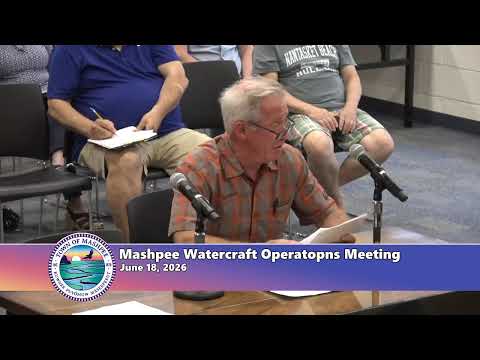
Ronnie Collins, Mashpee town manager, opened a town‑led operational meeting to gather public input on complaints about jet skis and other boating behavior on Mashpee–Wakeby ponds, saying the goal was to collect concerns and follow up rather than make any decision that night.
Resident organizer Sam Fisher told the meeting his top objective was “the full ban of personal watercraft on our lake,” and urged residents to pursue both a long‑term ban and immediate increases in enforcement. “We need help from the state,” Fisher said, asking the Massachusetts Environmental Police to patrol the lake on weekend days.
Supporters of a ban said jet skis are noisier and more hazardous than other craft and have been displaced from smaller Cape Cod ponds. “They are fundamentally more dangerous,” said Joshua Goldberg, a longtime Mashpee Wakeby resident. Sarah Key, who lives on South Sandwich, said she favors a ban for environmental reasons: she told the meeting that jet skis operating in shallow water can churn and spread cyanobacteria blooms, making swimming unsafe.
Other residents opposed a ban, urging stronger enforcement, clearer ramp signage and targeted deterrence. Carrie Lore, of John’s Pond, said education and visible harbormaster presence matter: “Safety is vital, but we cannot let a few bad actors ruin it for everyone,” she said. Several speakers recommended stepped‑up checks at launch ramps for registration, required safety gear and, where appropriate, civil citations or voyage termination for unsafe operation.
State officials at the meeting outlined jurisdictional limits and tools. Terry Smith of the Office of Fishing and Boating Access (the state office that manages boat‑access facilities) said his office primarily manages land‑side aspects of state facilities and grant funds and does not by itself regulate waterbody traffic. He noted that land‑management agreements can be amended through staff drafting and select‑board approval and cautioned that imposing a restriction on a waterbody can set precedents across the Commonwealth.
Environmental Police representative Peter Borgal and other enforcement officials described the tools they use: plainclothes and saturation patrols, ramp safety inspections, civil citations for unsafe operation and, in specific cases, voyage termination when safety elements are violated. They also said the new Hanson‑Malloy boating‑safety requirement will initially be enforced administratively and that fines and a full enforcement schedule will phase in later in the year.
Officials and residents discussed precedents. Speakers described how Sandwich implemented a jet‑ski ban on Peter’s Pond via a town‑meeting bylaw and Attorney General review; several noted Mashpee–Wakeby differs because the ponds cross municipal lines and exceed acreage thresholds that can change the approval pathway. Town and state staff pointed to a statutory framework (including 320 CMR 2.00 and Chapter 90B) that shapes who can set and approve restrictions.
Officials also highlighted near‑term, practical steps under consideration: increased weekend harbormaster patrols where staffing permits, targeted saturation enforcement with Environmental Police and local police, consolidating and clarifying signage at the ramp kiosks, exploring seasonal or grant‑funded staffing, using the Coast Guard Auxiliary or volunteer programs to expand visible presence, and reviewing the state‑town land‑management agreement that governs the facility.
Terry Smith said the state had mailed a quarter‑million dollar payment tied to reconstruction and stormwater management at the public access facility; that project and its stormwater improvements will be referenced in any agreement updates.
Several residents urged quick action on enforcement around high‑use times (Sundays and holiday weekends). Officials acknowledged staffing and budget limits but said they would pursue practical increases in presence and suggested forming a multijurisdictional task force or seeking targeted funding. The town manager said staff would note public concerns, follow up with departments, and raise options with the select board.
The meeting ended with an immediate public‑input opportunity: Sandwich’s Conservation Commission will take additional comments on Ryder Conservation Land rules at a July 1 meeting at Sand Hill School. Harbormaster and town contact information was given for follow‑up, and residents were reminded to call police dispatch (or 911 for emergencies) for incidents needing immediate response.