Get Full Government Meeting Transcripts, Videos, & Alerts Forever!
Get email alerts on the Wastewater Infrastructure topic
No spam. Unsubscribe anytime.
Palm Bay begins startup of South Regional Wastewater Reclamation Facility
Summary
Gabriel Bowden, Palm Bay utilities director, outlined startup tests, seeding and phased operations for the South Regional Wastewater Reclamation Facility, which will initially treat roughly 300,000–400,000 gallons per day and can scale to 1 million gallons per day.
Gabriel Bowden, utilities director for the City of Palm Bay, gave a tour and status update on the South Regional Wastewater Reclamation Facility as the plant enters startup.
"We're in the process of startup here," Bowden said, describing a commissioning sequence the city will follow over the coming weeks. He said the plant is intended to provide up to 1 million gallons per day of wastewater treatment for the city once fully scaled.
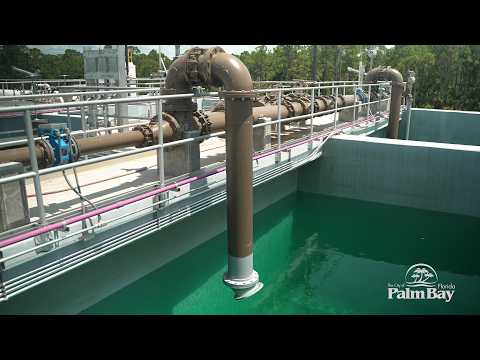
Bowden described the treatment process: wastewater arrives via a force main into drum screens that remove large debris, then moves into an anoxic zone where solids settle, into another settling basin, and is pumped into an aeration basin where added air supports the biological breakdown of waste. "From there the water goes into the MBR filters and all the remaining sludge is removed," he said.
Treated water will be routed to a ground storage tank with two main options: reuse for irrigation lines or disposal via a deep injection well. Bowden said that when the plant first opens, the majority of treated water will be sent to the deep injection well, and reuse will expand as new irrigation lines are built in the southeast.
Bowden outlined the immediate startup tasks: technicians are performing I/O checks of electrical components to confirm communications, then will run wet checks on pumps and motors to verify flows. "After we're done with the wet checks, if there's anything that needs to be fixed, we'll fix that," he said. He added that next week the plant will be seeded with material from another facility so biological treatment can begin and flows will be introduced.
He characterized the plant as a membrane-based treatment facility and said initial operations will treat about 300,000–400,000 gallons per day, expand to 1 million gallons as growth continues, and could reach 2 million gallons in the future with existing basins on site. "It's not just flipping a switch and being ready to go," Bowden said, calling the commissioning process multi-step and stressing the benefit to the growing southeast region and the entire city.
The city did not provide a schedule beyond the next-week seeding plan, nor did the update include funding sources or permits for reuse expansion.