Get Full Government Meeting Transcripts, Videos, & Alerts Forever!
Get email alerts on the Teacher Support topic
No spam. Unsubscribe anytime.
Thomasville City Schools board updates beginning-teacher support plan, stresses stronger mentoring and retention tracking
Summary
The Thomasville City Schools board approved a revised Beginning Teacher Support Program that formalizes mentor selection and professional development and expands coverage for teachers with under two years’ experience. Board members pressed for measurable retention and clearer monitoring.
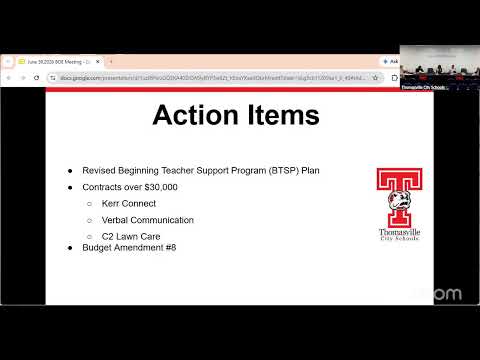
The Thomasville City Schools Board of Education approved revisions to its Beginning Teacher Support Program after a staff presentation and questions from board members.
Dr. Kelly Hayes presented the revised plan, saying it adds two required elements under current EIP guidance: incorporation of a graduate-study class into the induction sequence and explicit inclusion of teachers who have fewer than two years of experience so their development is tracked within the five-year induction window. “We updated not only the policy changes, but we also added information which represents the activities and the strategies that we provide to our beginning teachers,” Hayes said.
Board members sought specifics about mentoring and how the district will guard against the process becoming a “check the box” exercise. “Are we really mentoring them? Are we going to mentor them? … How are we going to monitor them closely?” asked board member Mr. Richard. Hayes said the district strengthened mentor notification and selection procedures, requires DPI mentor training, holds beginning/mid/end-of-year feedback cycles and will provide additional professional development for mentors. “Mentors must complete a DPI mentor training,” she said, and the district hosted a regional session recently with strong attendance.
On measurement, Mr. Richburg asked how the district would determine whether the revised plan is succeeding given past shortcomings. Hayes pointed to multiple metrics: year-to-year retention data for beginning teachers (reported to the state), program outputs, surveys and regular meetings with beginning teachers that capture successes and areas of struggle. “Ultimately, this is about student outcomes as well,” she said, noting the district will compare multiple data points to identify where teachers need support.
Board members also asked whether the district could operate its own educator preparation program (EPP) to control licensure processes. Hayes said EPP approval is state-regulated and costly for a small district and that districts that hold EPP status still rely on local funds to support participating teachers. She offered to return with historical retention numbers for a timeframe the district finds reasonable.
Hayes described additional supports such as online and in-class test-preparation, fee reimbursements when teachers complete licensure requirements and multiple delivery options (online, in-person, hybrid) for educator-prep coursework. The board approved the revised plan by motion and voice vote.
The board scheduled follow-up to provide retention figures and related program data so members can evaluate the revision’s impact over a specified monitoring window.