Get Full Government Meeting Transcripts, Videos, & Alerts Forever!
Get email alerts on the Espert Implementation topic
No spam. Unsubscribe anytime.
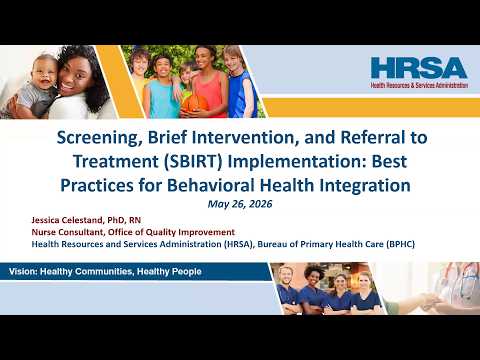
HRSA and SAMA webinar highlights ESPERT best practices for health centers
Summary
Federal and grantee experts outlined how the ESPERT framework (screening, brief intervention, referral to treatment) can be implemented across clinical and community sites, emphasizing universal screening workflows, staff champions, fidelity checks, and measurement to improve early identification and treatment of substance use and co‑occurring mental health conditions.
Health Resources and Services Administration officials and SAMA partners convened a webinar on ESPERT — the evidence‑based screening, brief intervention and referral to treatment framework — to share implementation lessons for health centers, schools and community settings.
At the opening, Larry Herlamus, quality division director in the Office of Quality Improvement at the Health Resources and Services Administration (HRSA), framed ESPERT as “a proactive rather than reactive model of care” for identifying substance use and co‑occurring mental health risks in primary care settings. Aden Watson of SAMA said the SAMA expert team currently manages 30 ESPERT grants and that “between 2021 and 2025, expert programs served more than 349,000 individuals,” a figure the panel used to illustrate program reach.
Panelists described the three‑part ESPERT workflow: an initial universal screen, a brief motivational intervention for those with elevated risk, and coordinated referral to higher levels of care when warranted. Patty Perazidis (Center for Advancing Prevention Excellence, University of Baltimore) explained the common two‑step screening approach: a short universal instrument followed by a secondary, validated screen if a patient screens positive to stratify risk (low, moderate, severe) and guide next steps.
Panelists stressed practical implementation steps. Summer Gerald (Virginia Department of Behavioral Health and Developmental Services) recommended identifying clinical, IT and executive champions before go‑live so staff understand roles and data flows; she said executive sponsorship is required in their implementations to maintain fidelity. The panel noted flexible administration options — paper, electronic, self‑administered or staff‑administered — depending on local resources.
Speakers from LA Master Community Health Centers described tool selection and piloting. Karen Hansen said the health center integrates age‑appropriate validated tools into registration (AUDIT and DAST‑10 for adults, CRAFT 2.0 for youth, PHQ‑9 for depression) and reported that the center had “about 53,000 patients last year.” She emphasized piloting tools with a test cohort and using evaluators to guide selection.
On quality assurance, panelists recommended tracking reach and fidelity in the EHR and using observational fidelity checks for brief motivational interventions (for example, counting open‑ended questions, affirmations, reflections, and summaries or using BNI interview scoring sheets). Evaluation teams said outcomes measurement should use multiple time points and person‑level comparisons where possible to assess meaningful change in substance use and functioning.
Panelists also discussed practical referral strategies when in‑house services are limited: build up‑to‑date referral lists with named contacts and language capacity, streamline handoffs for high‑volume settings (for example, emergency departments), and use case managers and transportation supports where feasible.
For next steps the webinar pointed participants to posted reference slides, contact information for the presenters and SAMA’s web page; SAMA noted a preliminary Notice of Funding Opportunity forecast for fiscal year 2026. Organizers said slides and recording will be distributed to attendees after the session.
The webinar closed with a reminder that ESPERT is a flexible framework: screening flags risk but local protocols must determine when to follow with full suicide risk assessments, safety planning or higher‑level care.