Get Full Government Meeting Transcripts, Videos, & Alerts Forever!
Get email alerts on the Audit topic
No spam. Unsubscribe anytime.
Audit flags year-end closeout weaknesses for Live Oak amid finance director transition; city receives unmodified opinion
Summary
An external audit presented June 29 found Live Oak's financial statements to be materially accurate but identified a significant deficiency in year-end closeout procedures after the long-tenured finance director's departure; auditors and council members discussed causes and next steps.
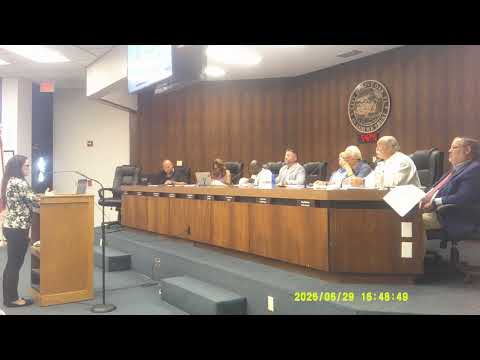
An external auditor told the Live Oak City Council on June 29 that the city's financial statements received an unmodified opinion but that a significant deficiency existed in year-end close and reporting procedures following a transition in the finance director position.
Curtis Carr, who presented the audit, said, "The city also received an unmodified opinion on the financial statements, simply stating that the financial statements are materially accurate as presented." He told council members the deficiency stemmed from reconciliations and closing procedures not being completed in a timely way after the long-term finance director left and that the office required additional adjustments to reach material accuracy.
The auditor described the finding as a common consequence of personnel turnover, noting what he called "knowledge bias": procedures and informal workbooks embedded over decades were not fully documented and therefore were not immediately available to successors. Carr also said the city attempted to implement a new payroll processor during the closeout period that failed, requiring payroll to be handled manually and contributing to delays in the year-end close.
Council members asked whether the former finance director, identified in the transcript as Joanne, should be blamed; Carr replied the finding was not an accusation of wrongdoing and emphasized the procedural and knowledge-transfer nature of the weakness. At one point a council participant said, "We didn't find any money missing," a point that Carr did not dispute in the recorded discussion.
Alongside the internal-control finding, Carr reviewed financial highlights from the fiscal year. He said intergovernmental revenue rose because of a FEMA reimbursement, public safety spending increased in part because of an annex building refurbishment (about $150,000), and the city purchased new vehicles and equipment. He noted transportation projects were a major budget outlier, with roughly $3 million in anticipated transportation projects not occurring as planned.
Carr emphasized large capital activity in enterprise funds tied to water infrastructure: a septic-to-sewer project funded through the South Suwannee River Water Management District accounted for roughly $5 million in capital contributions, and additional waterline improvements totaled about $2 million; he said business-type activities recorded about $6.6 million in construction in process during the year. The auditor also noted $653,000 in deletions from construction in process that flowed into additions as projects completed.
The report included a federal single-audit because expenditures from the Coronavirus State and Local Fiscal Recovery Fund exceeded $1 million during the year; Carr said the state-level single-audit threshold (about $750,000) was also met for a statewide water-quality program. He told the council the Auditor General-required financial condition assessment determined the city to be in a "very, very strong financial position," and no compliance findings were noted under the state statute cited in the report.
The presentation generated questions from council members but no motions or formal actions on the audit itself were recorded in the transcript. The audit materials and a management letter were provided to the council; Carr pointed to the management letter and required communications as the venue for next steps and for tracking corrective actions to strengthen year-end close procedures.
What happens next: Carr said the finding will merit attention from those charged with governance and implied that documenting closeout steps, rebuilding checklists and workbooks, and addressing the payroll-processor failure would be practical next steps. The transcript does not record a formal vote to accept or act on the audit beyond the earlier procedural approval of the meeting agenda.
Note on sources: This article is based on the June 29 audit presentation and Q&A recorded in the council transcript; direct quotations and figures are drawn from the auditor's presentation and the council exchange.