Get Full Government Meeting Transcripts, Videos, & Alerts Forever!
Get email alerts on the Spiritual Care topic
No spam. Unsubscribe anytime.
FDA panelists say spiritual care, religious literacy improve cancer care and help reduce clinician burnout
Summary
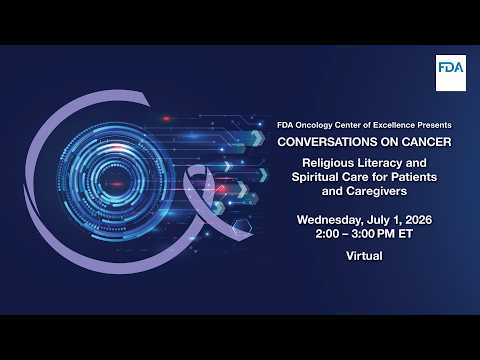
During a June Conversation on Cancer hosted by the FDA Oncology Center of Excellence, clinicians and scholars said integrating spiritual care and religious literacy into cancer treatment supports patients and families and can reduce burnout among clinicians; speakers described Reflection Rounds, chaplaincy links and curriculum efforts.
In a virtual Conversation on Cancer in June, officials and clinicians gathered under the FDA’s Oncology Center of Excellence to argue that spiritual care and religious literacy are essential parts of whole-person cancer care and can also help mitigate caregiver and clinician burnout. Steve Cunningham, a surgeon and clinical reviewer in the FDA Division of Oncology 3, moderated the discussion and framed the session around how spiritual care affects patients, families and clinicians.
Dr. Christina Puchalski, a palliative-care physician at George Washington University Medical Faculty Associates and founder of the GW Institute for Spirituality and Health, said clinicians should treat spirituality as a distinct dimension of care. “Spirituality may be that inner part, that search for ultimate meaning, purpose, and transcendence,” she said, adding that clinicians should ask patients about their spiritual needs as part of whole-person care rather than beginning with a faith-specific question.
Suzanne Watts Henderson of Interfaith America recommended a pluralistic approach based on what she summarized as three verbs: “respect, relate, cooperate.” She said clinicians should suspend assumptions about patients’ beliefs and engage diverse ways people find meaning—whether through faith communities, nature or other relationships—to build trust and improve decision-making.
Panelists emphasized caregivers as part of the care unit. Gwynn Isen, a medical oncologist and clinical reviewer in the FDA Division of Oncology 1 and a two-time cancer survivor, described how including family members in visits (with patient consent) clarifies social context and can change treatment conversations. Dr. Puchalski said clinicians should routinely check on caregivers’ well-being and connect them to supports when possible.
Speakers connected spiritual care to clinician resilience and described concrete programs used in training and practice. Suzanne Watts Henderson described Reflection Rounds—structured sessions that start with silence and allow trainees or clinicians to share emotionally meaningful patient encounters without interruption—and said the practice restores a sense of vocation. The panel also pointed to chaplaincy programs and hospital-to-faith-community volunteer linkages that can sustain patients after discharge.
Panelists acknowledged systemic barriers, including brief clinic visits, electronic health record checklists and limited institutional bandwidth. They said these constraints make integration challenging but argued that spiritual-care practices can ultimately save time and reduce burnout by increasing the meaning of patient encounters.
The session closed with practical takeaways: clinicians should include caregivers in conversations when appropriate; health systems should consider low-cost, replicable practices such as Reflection Rounds and chaplaincy connections; and medical education should create sustained space for training in religious literacy and whole-person care. The moderators closed by encouraging viewers to look for additional Conversations on Cancer from the FDA Oncology Center of Excellence.