Get Full Government Meeting Transcripts, Videos, & Alerts Forever!
Get email alerts on the Land Use And Development topic
No spam. Unsubscribe anytime.
Morro Bay staff: former elementary site is technically suitable but cost will decide whether city buys it
Summary
City staff told a community meeting that surveys, a Phase I environmental assessment and historic-resource reviews show the 9.7-acre former Morro Elementary site is broadly suitable for reuse, including housing or a new city hall, but asbestos remediation, structural work and financing remain unresolved; the council will review findings in August with a key deposit deadline of Aug. 31.
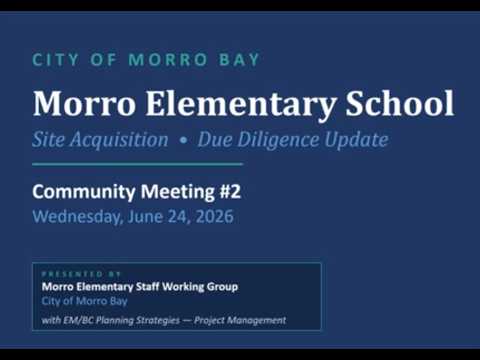
City Manager John Craig and project manager Michael Codran told residents at a June community meeting that technical studies so far show the former Morro Elementary campus is suitable for reuse, but that rehabilitation costs and the city's financing choices will determine whether the city completes the $5.3 million purchase.
Craig said the 9.7-acre property is under agreement with the school district for $5.3 million and that the city has paid $500,000 in earnest money. He told the audience the deposit is refundable until Aug. 31 and becomes nonrefundable thereafter, and that the remaining purchase balance is due by Oct. 31 if the city proceeds.
"This is our second community meeting regarding the purchase of the former Morro Elementary site," Craig said, framing the session as an update on findings and an opportunity for further public input before the council takes direction in August.
Project manager Michael Codran summarized the city's due diligence program. An ALTA survey confirmed property boundaries, and a Phase I environmental site assessment by Earth Systems "came back clean," Codran said, reporting no recognized environmental conditions that would require further contamination investigation. Padre Associates' asbestos and lead testing of the main schoolhouse and addition identified asbestos and lead at levels typical for a building of its age and about 600 square feet of friable asbestos-containing duct lagging that will drive mitigation costs in any rehabilitation.
"It came back clean," Codran said of the Phase I assessment, adding that the asbestos findings were expected for a 1936-era building and can be managed using standard abatement practices.
On historic significance, staff presented an inventory prepared by Friends of Morro Elementary and a peer review by LSA Associates concluding the campus is eligible for the California Register of Historic Resources. Staff said eligibility does not bar adaptive reuse but does require compliance with appropriate standards and CEQA review when changes to the resource are proposed.
Because many technical reports are still pending'including structural, mechanical/electrical/plumbing and high-level cost estimating'Codran and other staff said the largest outstanding question is how much it will cost to rehabilitate the historic buildings for a public use such as city hall, or to prepare the site for housing and open space.
Finance Director Emily Conrad briefly outlined the city's fiscal position. "In our general-fund emergency reserve we have approximately $7.8 million," she said, noting that using reserves would reduce the city's cushion for other capital needs and that staff intends to present specific financing options to the council in August.
Staff presented three illustrative reuse scenarios to prompt community feedback: a housing-forward plan with higher unit counts, a balanced mixed-use option, and an open-space-forward plan with fewer housing units and more parkland. Officials emphasized those scenarios were visual examples, not recommendations.
Public-comment speakers repeatedly urged preserving the site's athletic fields and green space for families and youth sports, questioned the scope of asbestos testing across all campus buildings, and pressed staff on the availability of appraisal and other due-diligence reports. Several residents and preservation advocates encouraged a community-led visioning process and public-private partnerships to help fund rehabilitation.
Members of the public also raised legal and title questions, including a longstanding claim cited by descendants that early deed language might impose limits on non-school uses; staff said title-review and title-company clearance are part of standard due diligence and that the city will investigate the records.
Staff said reports will be posted online for public review and reiterated the schedule: delivery of a draft due-diligence packet to staff/subcommittee in July, a presentation to the full council as a business item on Aug. 25, and the Oct. 31 escrow deadline. The city will decide whether to complete the purchase before the Aug. 31 nonrefundable-deposit date.
The city did not take a vote at the meeting; the session was framed as information-gathering ahead of an anticipated council decision in August.