Get Full Government Meeting Transcripts, Videos, & Alerts Forever!
Get email alerts on the Water topic
No spam. Unsubscribe anytime.
Hamilton board presses for water resilience, eyes interconnection with Wenham
Summary
At a June 29 workshop the Select Board prioritized measurable steps to shore up water resilience: use a new EPA grant to improve an interconnection with Wenham, pursue options for a secondary source, and accelerate work on aging tanks and mains.
Hamilton’s Select Board spent the bulk of its June 29 workshop on water infrastructure, hearing staff and members map out near- and long-term options to protect the town’s water supply and support measured growth.
Town staff said Hamilton’s municipal system is meeting the new EPA PFAS standards, reporting non-detect levels for PFAS in town-supplied water. But the board was reminded that the Ipswich River watershed limits available source water: the system can legally draw more than it currently uses, yet dry-season river conditions constrain additional withdrawals. That constraint, combined with aging assets, led members to press for a clear, measurable goal to advance a second-source strategy this year.
The Town has nearly $1.1 million in federal grant funding to improve an interconnection with the neighboring town of Wenham (referred to in the discussion as Winnham/Wenham). Staff said the grant will enable design work and initial construction for a stronger interconnection; the next step is coordination with the EPA project manager to start the project.
Board members and staff outlined alternatives for increasing resilience: a standalone treatment plant for neighboring Wenham was estimated in the discussion at roughly $8–12 million, while a more substantial build-out of treatment and distribution capacity could be in the $12 million range. One option under consideration is a regional model in which Wenham would pump raw water to Hamilton’s treatment plant and Hamilton would return treated water, a configuration staff described as promising but in very early stages.
Members also highlighted needs inside the system: many distribution mains date to the 1940s–1950s and require phased replacement; an aging tank in the Brownsville area was discussed as a potential five- to seven‑million-dollar capital project (tank plus proportional distribution upgrades). Staff reported roughly 40% of the distribution network has been replaced in a recent program; the remaining 60% remains on the schedule for future work.
On operational metrics, town staff said state reporting estimates Hamilton’s system water loss at about 13–15% (state guidance suggests an ideal range near 10–12%), and the town tracks leakage as part of its annual reporting. Board members encouraged more routine leakage monitoring, valve exercising, and communications with residents so the public better understands limits on irrigation and growth capacity.
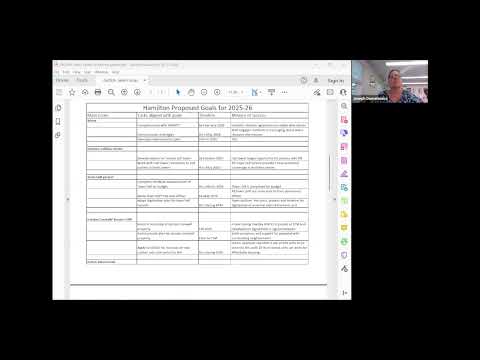
The board asked staff to make a water-resilience goal for the coming year: advance the Wenham interconnection using the grant, determine whether the town will commit to partnering on a regional plan, and produce a public one-page summary and a public water meeting to explain system capacity, constraints, and timing. The Select Board said it expects follow-up design milestones and clearer timelines at future meetings.
The board discussed next steps for community engagement and ordered staff to prepare a communications package and a plan for a one‑night water forum similar to a 2019 meeting. The Switch River Watershed Association and regional partners were identified as likely contributors to message content and benchmarking.