Get Full Government Meeting Transcripts, Videos, & Alerts Forever!
Get email alerts on the Property Tax topic
No spam. Unsubscribe anytime.
Scarborough hearing pits waterfront property owners’ appraisals against town’s post‑2012 revaluation
Summary
Property owners and their expert witnesses told Scarborough’s Board of Assessment Review that the Great Recession and subsequent market evidence left waterfront values below pre‑2007 levels. Town officials said state sales‑ratio procedures and paired‑sale analysis supported targeted land‑value adjustments; the board set deadlines for briefing and deliberations.
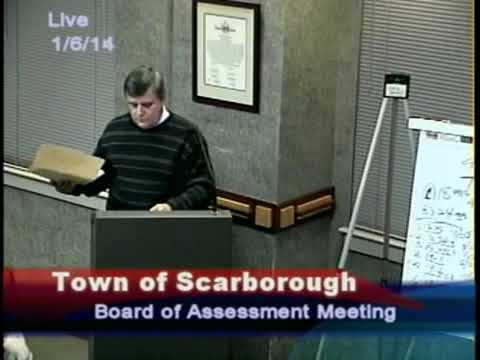
At a Jan. 7, 2014 hearing before the Scarborough Board of Assessment Review, property owners challenging the town’s 2012 revaluation presented expert testimony arguing that waterfront home values, especially in Prout’s Neck, had fallen since the 2005 revaluation and the 2007–09 recession.
John Block, attorney for a group of waterfront property owners, called George E. calakas, a certified appraiser with Sterling Appraisal Company, who told the board he had 35–40 years’ experience in the Prout’s Neck market and that his analysis showed “market evidence” of lower sale prices after the recession. Calakas summarized paired‑sale and state report data he said showed a meaningful divergence between assessments and contemporaneous sales for many waterfront parcels and that in some cases sales prices fell substantially from pre‑recession levels (for example, a 2006 sale at about $2.3 million that later sold in 2013 for roughly $1.5 million).
Calakas also calculated that a smaller share of waterfront and water‑influenced sales fell within the 90–110% assessment‑to‑sale ratio compared with other residential properties and said that pattern suggested unequal treatment between waterfront and non‑waterfront classes.
Town officials and assessors disputed those conclusions. William Healey, Scarborough’s tax assessor, said the assessor’s office followed state sales‑ratio guidance and that the 2012 revaluation improved Scarborough’s overall ratio and the quality rating for sampled groups. “The true test is where they fall in the state sales analysis ratio studies and the quality ratings,” Healey told the board, describing the adjustments as intended to improve equity across neighborhoods.
Healey and other town witnesses also challenged the reliability of several sales cited by the taxpayers’ expert, noting some transactions were private sales, intra‑family or otherwise not clearly exposed to the open market; the town’s staff said it excludes or flags sales that do not meet state criteria for inclusion in ratio studies. The assessor singled out particular parcels and sales (including a post‑April‑1 sale that the town said raised questions about exposure, easements or current‑use status) and said the office would review outliers for the next assessment year.
Local broker Leslie Craig, who tracks Prout’s Neck listings, agreed that water views commonly affect prices but said she knew of no series of arms‑length, contemporaneous sales that would by themselves support the townwide 14% land‑value bump some taxpayers contested. Counsel for the town and taxpayers repeatedly pressed witnesses about whether individual sales were arms‑length and whether listing exposure or special motivations for a buyer or seller made them reliable comparables.
The board also handled a separate procedural matter at the meeting: Attorney Bill Dale disclosed that a board member, Mr. Frothingham, had been a past and continuing client of his firm in unrelated trust and estate matters. Town counsel reported no objection; the board moved, seconded and voted unanimously to allow Mr. Frothingham to continue participating in the case.
The board closed by setting deadlines for post‑hearing written submissions and asked both sides to file concise memoranda and exhibit cleanups ahead of a scheduled follow‑up deliberation. The board did not reach a final decision on the appeals during the session.
The town will continue reviewing flagged sales and outliers for the April 1, 2014 cycle; the board scheduled further filings from parties to help it weigh the competing appraisals and whether adjustments to assessments are warranted.