Get Full Government Meeting Transcripts, Videos, & Alerts Forever!
Get email alerts on the Waterfront Resilience topic
No spam. Unsubscribe anytime.
Consultants present North Haven waterfront resilience concepts; residents warn about ecological and visual impacts
Summary
Consultants outlined a plan to raise waterfront elevations, extend a bulkhead, and relocate the ferry terminal to improve resilience. Residents and environmental experts urged prioritizing ecological integrity and aesthetics and warned that seawalls and added hardscape could shift erosion and diminish the town’s character.
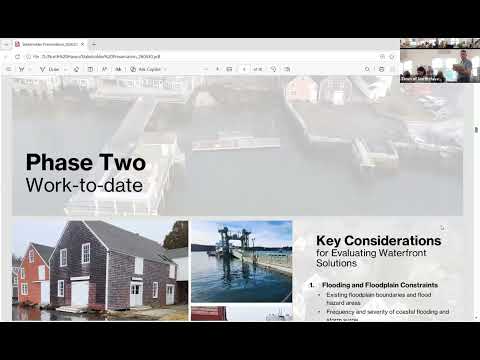
Consultants from Musen Group and GBI presented a conceptual waterfront resilience plan to the North Haven Select Board that proposes raising finished ground and building elevations, extending a bulkhead into deeper water, and relocating and elevating the ferry terminal to improve circulation and access.
"This figure here is showing what a king tide would be — the highest astronomical tide with one and a half feet of sea level rise — around 2050," said Leela Pike, a civil engineer at GBI, describing flood scenarios the team used in Phase 1. Pike said the consultants are recommending design to the regulatory finished-floor elevation of 12 feet (with buildings elevated to 13 feet) so renovated structures meet floodplain requirements.
The presentation outlined three linked goals: flood resilience, improved functionality for ferry and working-waterfront operations, and public waterfront amenities. Nolan Musen of the Musen Group described concept elements including a widened pier with an approximately 80-foot gangway to reduce ramp steepness and improve accessibility and an option to shift some working-waterfront uses toward Brown’s Wharf to create space for a clearer ferry drop-off, short-term parking and a public waterfront plaza.
Consultants emphasized engineering and permitting constraints. They described modular precast bulkheads that can be barged to site, the need for geotechnical borings, and possible pile-supported structures where permitting or ecology make infill impractical. "Permitting is a consideration," Pike said, noting that both state and federal marine regulators would play roles in any final design.
Public comment focused on ecological risk, aesthetics and parking. A resident who identified herself as an environmental scientist urged the board to treat ecological integrity as part of the resilience strategy and cautioned that long seawalls and expanded hardscape can increase erosion pressures on neighboring shorelines and require ongoing rip-rap and maintenance. "You can't separate resilience from ecological integrity," she said, urging early integration of natural options such as rain gardens, vegetated swales and other stormwater measures.
Alice Cornell, who spoke during public comment, warned that pushing the parking and bulkhead out 30–40 feet in places could create "a vast area of concrete" that would alter North Haven's historic waterfront character. Several residents suggested staged or seasonal parking strategies and said preserving visual character should be treated as a design objective, not an afterthought.
Consultants said they will refine cross-sections and elevations, work with stakeholders (including ferry operators, Browns and other waterfront property owners), and post larger-format maps online. They asked residents to send written comments to town staff member Rebecca and indicated a follow-up public process and additional technical work would be required before any permit applications or construction.
The Select Board did not vote on the concept; the meeting served as a public sharing of draft ideas and a request for feedback. Consultants said the plan is a conceptual starting point and that future iterations will refine trade-offs among resilience goals, ecological impacts and community values.