Get Full Government Meeting Transcripts, Videos, & Alerts Forever!
Get email alerts on the Transportation topic
No spam. Unsubscribe anytime.
Pawtucket committee approves revised elementary start times to cut transportation costs
Summary
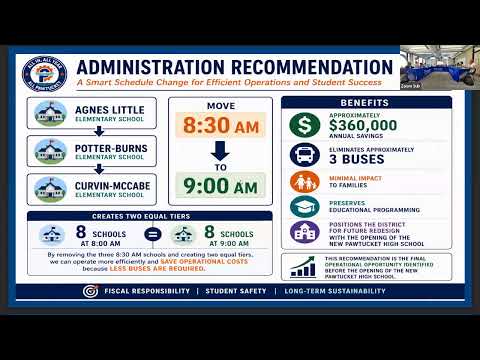
The Pawtucket School Committee unanimously approved shifting start times at four elementary schools to reduce bus deadhead time. Officials said the changes, combined with routing improvements, could cut about three buses and save roughly $360,000 annually, with prior operational changes already equivalent to about five buses (~$600,000).
The Pawtucket School Committee voted unanimously to approve the superintendent's recommendation to adjust elementary bell times for four schools as part of a transportation optimization plan intended to reduce bus usage and operating costs.
Superintendent Buck said the proposal reflects nearly a year of route analysis, independent reviews and vendor input, and stressed that student safety remained the top priority while pursuing fiscal stewardship. Dr. Andrade, who presented the routing analysis, told the committee the district and outside consultants reviewed contracts, routing software outputs and special-education transportation needs before arriving at the recommendation.
District officials said operational improvements already implemented reduced the district's need by the equivalent of about five buses, representing roughly $600,000 in annual savings at an assumed per-bus cost of $120,000. The committee-approved bell-time change is projected to eliminate about three additional buses and save an estimated $360,000 annually, which administrators described as the largest remaining, low-disruption option identified by First Student and the outside analyst.
Under the approved plan, the administration will move three elementary schools currently on an intermediate 8:30 a.m. start into an 9:00 a.m. tier (the presentation cited Agnes Little, Potter Burns and a Curvin/Curvin Richards/Curvin McCabe entry in the record) and make a 10-minute alignment for Jacqueline M. Walsh. Administrators said the shift creates a balanced two-tier morning model that reduces idle "dead head" bus time and improves route efficiency.
Committee members pressed for details and alternatives during a lengthy question-and-answer period, asking whether changing different schools or adjusting outskirts schools would yield greater savings. Administrators said they had explored other scenarios — including relocating certain special-education programs (one cited example saved roughly $120,000) and aligning pre-K start times — and that those options had already been implemented where appropriate. First Student re-ran route-level analyses that incorporated local geographic and special-program constraints and recommended the tier balancing described to the committee.
Members and parent-perspective speakers raised concerns about family impacts, sibling schedules, morning and afternoon supervision, and child-care costs. The administration said it would work with principals to expand before- and after-school supervision and explore partnerships to support siblings who would otherwise face an hour gap between drop-offs. The special education office said it coordinates IEP transport accommodations in advance with the vendor and can procure necessary harnesses or specialized buses if required.
The motion to adopt the superintendent's schedule changes was moved and seconded and passed on a unanimous roll-call vote. The committee requested regular oversight: several members asked for early check-ins (for example, in October or November) and suggested quarterly updates or a transportation subcommittee to monitor impacts, sibling transitions and the fiscal results.
The district said it will proceed with implementation planning, route adjustments and family communications before the next school year, while monitoring operational performance and the agreed oversight checkpoints.