Get Full Government Meeting Transcripts, Videos, & Alerts Forever!
Get email alerts on the Parks And Open Space topic
No spam. Unsubscribe anytime.
City rangers outline strategic trails plan, stress volunteer role and motorized-vehicle ban in open space
Summary
San Luis Obispo City staff presented a strategic trails plan to formalize trail design and maintenance across the city’s 4,000+ acres and roughly 60 miles of trails, invited public participation and volunteers, and reiterated that motor-propelled vehicles are not permitted on city open space per municipal code.
SAN LUIS OBISPO — City staff presented the San Luis Obispo City strategic trails plan and a decade of trail design lessons at a public meeting, describing how the city will treat trails as a connected system and inviting volunteers and stakeholders to help prioritize future projects.
"We live in the best place there is to live," said Bob Hill, head of the city's Office of Sustainability and Natural Resources, who opened the meeting by tracing the city’s open-space program back to early planning in the 1990s and the hiring of the program’s first staff in January 1996. Hill said the city now manages more than 4,000 acres across 13 public open-space properties with roughly 60 miles of trails.
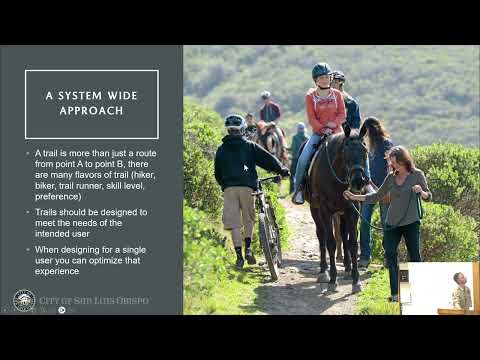
Ranger Neils Grether, lead for trail projects in the City Ranger Service, said the proposed strategic trails plan will codify design standards, maintenance expectations and "user-focused management standards" so the city can build and maintain trails that meet distinct user experiences — from hiking-only routes to progressive mountain-bike features — while protecting sensitive habitat and reducing user conflict.
"We’ve shifted from multi-use trails to a multi-use trail system," Grether said, describing a mix of single-use and multi-use trails that he said improves user experience and reduces points of conflict by routing different activities to appropriate corridors.
Grether walked attendees through the city’s design process: reconnaissance and GPS mapping, botanical surveys to avoid sensitive areas, iterative rough and fine flagging, then construction using small mechanized equipment or hand crews where precision is needed. He emphasized trail monitoring and seasonal maintenance — including 25–35 volunteer hours per week that supplement seven full-time rangers and seasonal staff.
During a public Q&A, Grether and staff addressed common management questions. On motorized devices, staff cited the city’s municipal code and said, in the city’s open space regulations, "anything that's propelled by a motor is not allowed in city open space." Enforcement, they said, is education-first with occasional citations for repeat or egregious violations.
Attendees asked about private-property trails, and Grether said the city sometimes maintains privately owned connectors only when a formal agreement exists; otherwise private trails remain the landowner’s responsibility. On trail removal and reroutes, he said successful closures require a better alternative route, plus active remediation and revegetation to discourage informal use of the old tread.
The presentation also covered accessibility and adaptive recreation. Grether said the city is developing an approach to rate trails for adaptive mountain-bike use and plans to measure trail width and obstacles to publish accessible-route guidance for riders with different mobility equipment.
Grether invited public participation in a stakeholder group and offered a QR code and email sign-up for updates. He said the strategic plan will be a public document and is intended to capture institutional knowledge — design standards, maintenance intervals and a roadmap for prioritized projects — so future staff and volunteers can sustain the system.
The meeting closed with staff noting the program’s long-term funding needs: the city currently balances acquisition and stewardship spending to keep both land purchase and maintenance viable. Staff encouraged volunteers to join recurring work crews and to sign up at slowrangers.org for project updates and notifications.
The city did not take formal votes at the meeting; staff said the immediate next steps are stakeholder engagement, drafting the strategic trails standards and continuing volunteer-led maintenance and selective construction projects.