Get Full Government Meeting Transcripts, Videos, & Alerts Forever!
Get email alerts on the Land Use topic
No spam. Unsubscribe anytime.
Awendaw planners deny Shell Ring preliminary plat, citing mixed‑use requirement and outstanding technical issues
Summary
The Awendaw Planning Commission denied preliminary approval for the Shell Ring (Shell Rain) residential planned development after the town attorney said the PD appears residential-only and may violate statutory mixed‑use requirements; staff also flagged unresolved fire access and other technical items.
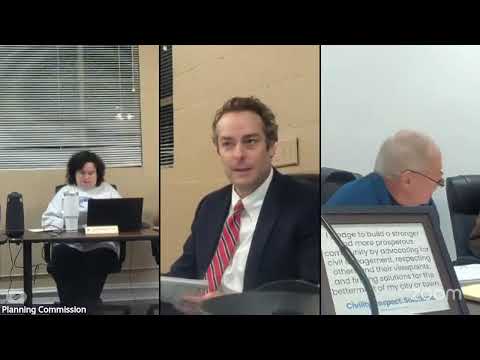
The Awendaw Planning Commission voted to deny preliminary plat approval for the Shell Ring (referred to in materials as the Shell Rain) residential planned development on July 6, saying the submission as written appears to conflict with the town's PD requirements and raises outstanding technical concerns.
The application, submitted by Stillwater Development, proposed 13 single‑family lots on a roughly 6‑acre parcel along Highway 17 (tax parcel 66100000025). Staff told commissioners the PD was rezoned and vested by council on March 2, 2023 and that one of five available one‑year vesting extensions has been used; staff said the PD is currently vested through January 1, 2027 but that certain approvals remain necessary before a final plat could be recorded.
A resident, Harry Green, who identified his address for the record, told the commission he was concerned the proposal is too dense and lacks the mixed‑use elements required by the PD ordinance. "Therefore, I'm not in favor and I would urge the commission to not permit this development in its current state," Green said during public comment.
The town attorney told the commission the preliminary plat and related PD documentation appear to show residential use only, which could render the PD invalid under governing law and relevant case law. "This PD frankly should have never been approved by council and I suspect if we challenge it, it would be invalidated by court," the attorney said, citing litigation on point.
Staff also identified outstanding technical items the applicant must resolve, including clarification of lot depth, confirmation of minimum buffer treatments along Highway 17 (the PD lists a 20‑foot minimum buffer), verification of fire‑apparatus turning radii and hydrant spacing, and plans for individual septic systems and water service. The planning director noted that, while some site design elements may be conditioned, the fire department sign‑off had not yet occurred and that is a valid basis either to deny or to conditionally approve the preliminary plat.
Representing the applicant, civil engineer Dave Cers said the team has worked with staff to address preliminary comments, reduced the lot count from 14 to 13, and added stormwater capacity. "We're also adding extra storm water to the system," Cers told commissioners and offered to submit full civil plans and water‑distribution calculations.
After discussion and a motion citing the town attorney's legal assessment and the outstanding technical concerns, the commission voted in favor of denying preliminary plat approval. The motion carried after a second and the chair called for the ayes; the meeting record shows the commission affirmed the denial.
Next steps: the applicant may revise the submission to demonstrate required mixed uses or to resolve the technical items and return to the commission, or seek other remedies. The town's options also include council review or, if challenged, adjudication in court; staff noted the PD remains vested for now under state law until the vesting period expires or a court rules otherwise.