Get Full Government Meeting Transcripts, Videos, & Alerts Forever!
Get email alerts on the Plan Development Rewrite topic
No spam. Unsubscribe anytime.
Awendaw planning panel advances wide rewrite of plan-development rules: 15-acre minimum, 20% open space, traffic studies required
Summary
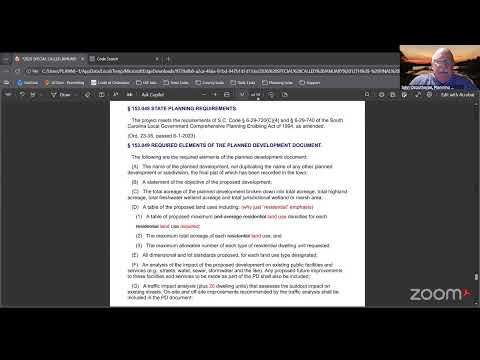
The Planning Commission advanced major changes to the town's plan-development rules, agreeing in principle to a 15-acre undisturbed-upland minimum, 20% gross usable open space, an 80/20 mix rule, a 1.5 dwelling-per-acre cap and a mandatory traffic-impact analysis (vote 3-2). Staff will draft precise language for next meeting.
The Awendaw Planning Commission spent most of its meeting overhauling the town's plan-development (PD) regulations, advancing a set of policy decisions and asking staff to prepare a redraft for another review before transmission to the Town Council.
Commissioners agreed on several substantive policy points during a lengthy, technical discussion: they instructed staff to set the minimum PD district size at 15 acres of undisturbed upland, increase required open space to 20 percent of gross area (excluding roads, drainage ponds, easements and other non-usable land), and adopt a mixed-use requirement that prevents token non-residential components (an 80/20 concept was discussed and accepted as guidance). The commission also set a maximum residential density of 1.5 dwelling units per acre and a minimum lot size of one-half acre, and voted 3-2 to require traffic-impact analyses for PD applications.
Key policy choices and why they matter - Minimum PD size and upland definition: Commissioners debated whether wetlands or buffers should be excluded from PD acreage. After discussion they settled on 15 acres of undisturbed upland to ensure PDs are used sparingly and to reduce the chance of developers relying on marginal or wet areas to qualify smaller sites. - Open space: The commission tightened the open-space requirement to 20% gross area and clarified that ponds, roads, utility easements and other non-usable land cannot count toward this requirement; staff was asked to draft more precise location and minimum-area standards so the open space is useable and accessible. - Mixed-use mix and prevents token uses: To avoid schemes that place a single small commercial use within a large residential project and call it mixed use, commissioners endorsed an 80/20-style composition rule (no single component should exceed ~80% of gross area) and told staff to include explicit language. - Density and lot sizes: Recognizing septic and rural-service constraints, the commission set a cap at 1.5 dwelling units per acre and a one-half-acre minimum lot standard; commissioners said the ordinance should still allow multiple dwelling types (estate lots, cottage lots, townhouses or duplexes) to meet the statutory PD definition of "multiple housing types." - Traffic studies and access: After discussion about thresholds and cost burdens, the commission voted (3-2) to make traffic-impact analyses mandatory for PD proposals and to reference industry standards (DOT and Institute of Transportation Engineers trip tables) when drafting the trigger thresholds. They also removed a rigid "one entrance per X parcels" formula in favor of a provision that a second (or more) access point may be required by the town for safety or connectivity.
Quotes that illustrate the debate - On the need for clearer open-space rules, Commissioner Kelly said: "Many PDs are counting drainage ditches, roadways, utility easements as open space and that's got to stop. The space must be large and usable by the residents." - On the size floor, staff summarized the commission's consensus: "Minimum size for a PD district shall be 15 acres of undisturbed upland," which commissioners accepted for the draft.
Next steps and outstanding items Staff will produce a redline draft that incorporates the numeric choices and clarifications discussed (upland definitions, exact traffic-analysis triggers, minimum-width language and the 80/20 mix formula). The commission also asked staff and the town attorney to prepare precise definitions (gross vs. net upland) and to check legal constraints on impact fees (the group removed an impact-fee charge from the draft pending a defensible study).
Because several technical definitions remain open (trip thresholds, whether certain minimum-width numbers will be fixed or advisory, and how to define and locate required open space), commissioners directed staff to return the next draft with those items filled in for final consideration before the document moves to council.
What residents should know: these changes would change when and how developers can propose planned developments in Awendaw, including a higher acreage threshold, stronger open-space protections and a mandatory traffic analysis for larger PD proposals. The draft remains subject to further drafting, legal review and the Town Council's final decision.