Get Full Government Meeting Transcripts, Videos, & Alerts Forever!
Get email alerts on the Municipal Audit topic
No spam. Unsubscribe anytime.
Council accepts FY2023–24 audit but members press for clearer reconciliations and earlier review
Summary
Auditor McGregor & Company issued an unmodified opinion for the town's FY2023–24 financial statements but reported a significant deficiency tied to repeated bank-reconciliation lapses; council voted to accept the audit while several members asked for earlier distribution, system fixes and follow-up training.
Neil Crider of McGregor & Company presented the town's fiscal year 2023'24 audit, saying the firm issued an unmodified (clean) opinion on the financial statements while identifying a reportable significant deficiency in internal control related to bank reconciliations. "We issue an unmodified opinion on the financial statements," Crider said, adding that the town "did not identify any internal control deficiencies that we consider to be material weaknesses" but did find a repeat issue on reconciliations that staff is remedying and for which the firm offered training.
Council members pressed staff for greater clarity about specific ledger practices and timing. "I got a real issue with um being okay on paper," said Council Member Kane, who criticized the town's continued use of manual ledgers and asked that the audit be provided earlier so members can review it before a meeting. Manager Hendricks and Crider told the council the finance team is moving to an electronic reconciliation process provided by the town's software (described as "public") beginning July 1 and that the transition should make reconciliations timelier for the FY2024'25 audit.
The audit also included a single-audit review of federal programs; Crider identified the Coronavirus State and Local Fiscal Recovery Funds (SLFRF/ARP) as a major program and reported "complied in all material respects" for the compliance requirements tested. On financial results, Crider reported the general fund increased its fund balance about $278,417, noting that an ARP transfer of $315,000 into the general fund partially offset a large fire truck bill and that, absent that transfer, the year would have shown a deficit on an operational basis.
Council debated the town's utility fund cash position and bond obligations. The auditor explained that much of the utility fund's improved net position resulted from capital grants recorded as construction-in-progress; he noted the town had roughly $4.2 million across utility cash and investment accounts and an outstanding water bond payment of about $3.525 million due June 30. "So we're break even at the moment," an exchange summarized during the presentation.
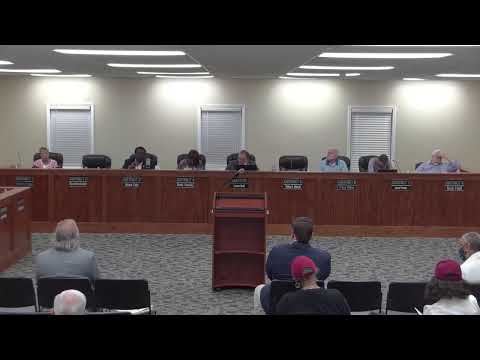
After discussion about the timing and depth of review, a motion to accept the audit as presented passed on roll call. Several council members asked for additional follow-up: more timely distribution of the audit documents ahead of meetings, training to reduce manual reconciliation work, and an agenda item at the April 28 budget workshop to explore how the reported revenues and transfers should inform FY2025 assumptions. The council did not direct any immediate corrective action beyond accepting the audit and asking administration to pursue reconciliations and training.