Get Full Government Meeting Transcripts, Videos, & Alerts Forever!
Get email alerts on the Cfd1 Budget topic
No spam. Unsubscribe anytime.
Douglas County considers up to 4.1‑mill levy to add 10 firefighters to Consolidated Fire District 1
Summary
County staff presented a supplemental request to add roughly 10 FTEs to Consolidated Fire District No. 1 — six firefighters, three captains and a battalion chief — citing volunteer shortfalls and long response times. Commissioners agreed to revisit direction July 10 ahead of a revenue‑neutral rate decision.
Douglas County commissioners spent their July 1 work session weighing a supplemental budget request that would add roughly 10 full‑time equivalent positions to Consolidated Fire District No. 1 (CFD1), county staff said. The proposed staffing package — six firefighters, three captains and a battalion chief — is intended to reduce long response times across the district’s roughly 230 square miles and bolster training, supervision and community programs.
County staffer Sean told commissioners the district runs about 1,000 calls a year from 10 stations with 38 apparatus, and the current full‑time roster is six firefighters plus two chiefs, an administrator and roughly 45 volunteers. "We do need a little bit of guidance as we're preparing the revenue‑neutral rate for consolidated," Sean said, framing the request as separate from countywide budgeting. He later summarized three options for commissioners: Option A (full implementation of all 10 FTEs), Option B (adds firefighters and captains but defers the chief), and Option C (adds only the six firefighter positions).
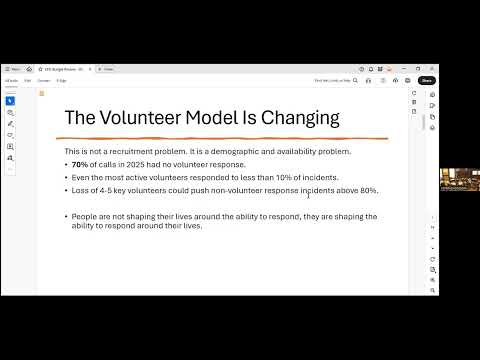
Staff and CFD leaders told commissioners the district’s volunteer model is strained: based on 2025 data, about 70% of calls had no volunteer response, and removing the five most active volunteers raises that shortfall to roughly 80 percent. Officials said that dynamic forces full‑time staff to handle many calls, increasing response times in a geographically large district; in some routes they said a responder’s travel time can reach about 20–25 minutes. Department leaders and staff pointed to an early‑year improvement in response times after adding two firefighters at a La Compton station, but stressed large parts of the district remain distant from staffed stations.
Commissioners and staff framed the request as a trade‑off between service and cost. Staff said the supplemental could be funded by raising a district‑specific mill levy and noted one cap under discussion would allow up to about a 4.1‑mill increase for CFD1; commissioners asked staff to return with more detail. "If we did hire all ten and have them ready Jan. 1, that would be ideal," one commissioner said, while others recommended more community outreach and data on who would bear the tax burden. Staff proposed returning to the topic in a July 10 budget follow‑up and to publish a revenue‑neutral rate for public hearing on July 15 before a final vote at the August 26 hearing.
Officials also discussed other implications and funding options: the district’s ISO insurance rating is currently a 5, and staff said improvements in staffing and training could lower that rating and benefit commercial insurance costs (residential benefit requires further improvements). Commissioners and staff reviewed federal grant opportunities — for example, SAFER grants that can temporarily fund personnel and AFG grants for equipment — and noted program timing, competitive awards and the district’s obligation not to "supplant" local funding after a grant cycle ends.
A question about funding sources generated additional detail. A commissioner said Douglas County received $72,000 in federal payment‑in‑lieu‑of‑taxes (PILT) in 2026; staff clarified that PILT funds are distributed to school districts and townships and that rural fire districts do not directly receive those payments, though federal lands do contribute call volume.
Commissioners did not take a formal vote on the supplemental request. They directed staff to refine levy and budget projections, provide maps and acuity breakdowns of call data, and return on July 10 with recommendations that could be included in the July 15 revenue‑neutral rate publication. The work session recessed until the 5:30 p.m. business meeting.