Get Full Government Meeting Transcripts, Videos, & Alerts Forever!
Get email alerts on the Trails Network topic
No spam. Unsubscribe anytime.
Pioneer Valley technical committee discusses state Priority Trails Network, seeks local convening to secure sewer‑corridor access
Summary
Regional planners reviewed MassTrails' equity‑focused Priority Trails Network and the New England Rail Trail, discussed how inclusion in those networks can improve funding prospects, and urged PVPC to convene utility and agency stakeholders to resolve access barriers to a proposed sewer‑corridor trail connection.
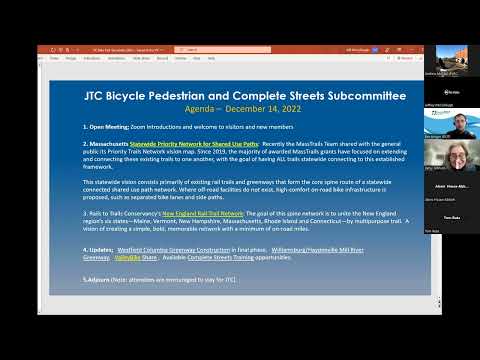
Members of the Pioneer Valley Joint Transportation Committee on the meeting discussed how the state’s MassTrails “Priority Trails Network” and the New England Rail Trail could inform a new regional bike and trail network. Staff said the state candidate network uses equity‑oriented metrics — including the share of residents and residents of color within a quarter‑mile of a shared‑use path, low‑income block groups and low‑vehicle households — to prioritize gaps for funding and construction.
“Those yellow segments are the gaps the state is trying to fill,” a staff presenter said, noting MassTrails often provides planning and seed funding while construction funds typically flow from the TIP. Committee members welcomed a shared map, saying a unified vision can help local projects compete for state and federal grants.
Several participants described local projects that could benefit from that alignment. Nick Dines, representing the Mill River Greenway in Williamsburg, said a sewer‑corridor corridor between the South End Bridge and the Farmington Canal Trail could provide a critical east–west connection. Dines and others said the sewer authority’s refusal to permit access is delaying the McKnight rail/trail connection and threatening MassTrails grant timing.
A participant said the group could play a convening role: “Could Pioneer Valley Planning Commission be the independent party to bring these people into a room or call?” Several members urged staff to organize a meeting with agencies, utilities and municipal officials to identify permitting and mitigation steps and to determine whether funding deadlines require an accelerated schedule.
Members also reviewed the Rails‑to‑Trails Conservancy’s New England Rail Trail and the East Coast Greenway, describing those plans as “bold visions” that can make small projects more competitive by demonstrating regional connectivity. Attendees suggested adding trail imagery to the statewide inventory (MassDOT/Google Street View) and volunteered to assist in data collection where local capacity exists.
The committee did not take a formal regulatory action on any trail project at the meeting. Staff said they would circulate feasibility plans that exist for the sewer‑corridor concept, convene interested parties, and follow up at future JTC meetings with any results of those discussions and permitting efforts.