Get Full Government Meeting Transcripts, Videos, & Alerts Forever!
Get email alerts on the Affordable Housing topic
No spam. Unsubscribe anytime.
Pioneer Valley Planning Commission leads regional bid for HUD PRO Housing grant to expand affordable housing
Summary
The Pioneer Valley Planning Commission and partner organizations unveiled a five-year HUD PRO Housing grant proposal to help 69 municipalities in western Massachusetts create and preserve affordable housing, prioritize local housing production plans, address zoning and septic barriers, and run a regional public engagement campaign; public comments are open through Oct. 11 and the application is due Oct. 15.
The Pioneer Valley Planning Commission, working with the Franklin Regional Council of Governments, Wayfinders, the Massachusetts Housing Partnership and other partners, outlined a federal grant proposal to secure HUD PRO Housing funds to support affordable housing work across 69 municipalities in western Massachusetts.
Katherine (director, Pioneer Valley Planning Commission) said the plan would update regional housing and land-use plans, assist all 43 PVPC member communities with housing production plans, and fund outreach and technical tools for housing authorities, developers, planners and advocates. "The goal of this funding from the federal government and our proposal is to say yes in my backyard," she said, describing a five-year effort to build local support and capacity.
The presenters cited multiple measures of regional housing stress. Katherine said the region “needs approximately 9,000 new housing units,” while presenters also referenced a prior UMass Donahue Institute housing study that projected a 19,000-unit supply gap in the Pioneer Valley by 2025 and noted that about 40% of households in the region are housing cost-burdened (more than 30% of income spent on housing). Tom Hopper (director, Center for Housing Data, Massachusetts Housing Partnership) and other partners said the project will standardize data and develop modeling tools to help local officials and residents understand development impacts and financing needs.
The team described four primary barriers the grant would address: lack of community support for new housing; restrictive local zoning that favors single-family lots; preservation needs for older housing stock; and infrastructure limits, notably septic-system constraints in rural communities. Katherine said the project would work regionally to match funding types to appropriate project scales, noting that some financing tools such as the low-income housing tax credit may be difficult to apply to small-scale western Massachusetts developments.
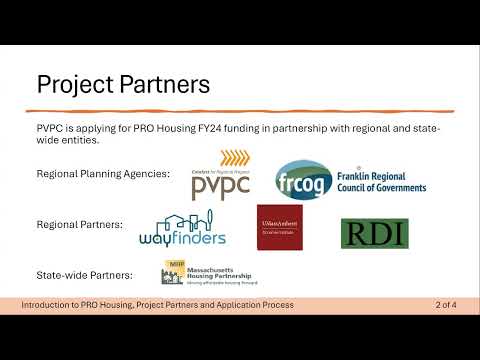
Partners’ roles were spelled out during the briefing. Franklin Regional Council of Governments will advance priority recommendations from its recent regional housing plan; Wayfinders will lead regional education and resident engagement; the Massachusetts Housing Partnership will support regulatory and planning tools; Rural Development, Inc. will assist barriers work in Franklin County; and the UMass Donahue Institute will provide data and modeling support.
PVPC will serve as lead applicant, said presenters, and expects to dedicate seven full-time staff to the project and coordinate roughly 20 professionals across partner organizations. Presenters said HUD awarded $85 million in FY23 for the program and that maximum award sizes have increased; applicants may request up to $7 million under the current funding round.
Project timing and next steps: presenters said they will post the full narrative application and recordings on the project webpage (materials to be posted around noon) and keep public comment open through Friday, Oct. 11; the HUD application is due Oct. 15. Panelists noted an anticipated project start date of Feb. 10, 2025 if awarded. Questions about sequencing drew a reply that housing production plan work would be staggered and prioritized—communities with older or missing plans would be addressed first rather than attempting simultaneous work on all communities.
Public commenters praised the emphasis on community engagement and urged attention to navigation services and accessibility. Karan said outreach is the "best part of this entire plan" for overcoming local opposition. Lisa, who described volunteer work with immigrant families and Habitat for Humanity, urged attention to Title Five septic restrictions and to community-building measures such as space for gardens; she said residents need help navigating services and argued for assistance that works outside typical office hours.
Alicia (participant) asked PVPC to provide the presentation to entitlement communities so local five-year Consolidated Plans can be aligned with the grant work. PVPC agreed to coordinate language and outreach with entitlement communities.
What happens next: PVPC will post the 40-page narrative application and a short survey for public comment, collect and attach public comments to the application, and submit the HUD application by the Oct. 15 deadline. If funded, PVPC and partners plan a five-year implementation focused on local housing production plans, state-level regulatory conversations (including septic rule discussions), and continued regional public engagement and fair housing work.
Sources and attributions are drawn from the public briefing recording and the presenters’ spoken remarks.