Get Full Government Meeting Transcripts, Videos, & Alerts Forever!
Get email alerts on the Beach And Coastal Regulation topic
No spam. Unsubscribe anytime.
Committee recommends ordinance to regulate Seabrook Island beach fires, authorize inlet swimming ban
Summary
The committee recommended Ordinance 2025-08 to the council, creating a town-issued beach-fire permit, setting safety and cleanup rules, allowing permit denial for those 'found guilty' of violations, and prohibiting swimming or wading in Captain Sam’s inlet except in emergencies. The measure includes annual designation of authorized fire locations and directs coordination with SAPOA and the fire district.
Seabrook Island — The committee voted to recommend Council consider Ordinance 2025-08, a comprehensive rewrite of the town’s beaches-and-waterways rules that would require town-issued beach-fire permits, tighten beach and dune definitions, and bar swimming or wading in Captain Sam’s inlet except in emergencies.
Joe, the presenter of the draft ordinance, told the group that the measure begins with a purpose statement to protect the coastal environment, preserve water quality and public safety and to conserve scenic and economic value. He cited state authority the draft relies on, noting the transcripted references that "any municipality that borders on the Atlantic Ocean ... jurisdiction extends one mile out" and that navigable-waterway jurisdiction covers the area between the high- and low-water marks.
The ordinance would make it unlawful "for any person to build, ignite or maintain a fire or open flame on the beach except as expressly permitted by this section," and it would create a new permit process. Applicants must provide name, contact information, the date, start and end times and the location of the proposed beach fire; an applicant who does not own the portion of dry sand where the event would occur must submit written authorization from the property owner (in most cases, the transcript notes, that is SAPOA). Joe said the town and SAPOA will need operational coordination so applicants can secure property-owner authorization and the town can issue the town permit.
On technical rules, the draft calls for pits approximately 3 feet in diameter and about 12 inches deep, prohibits chemical accelerants (gasoline, kerosene, lighter fluid), permits only clean dry firewood, and requires extinguishing fires by 10 p.m. with water "until cold to the touch," removal or burial of ashes at least 12 inches below the surface, and restoration of the sand. Applications must be submitted at least two business days before the event (the draft allows up to six months advance issuance) and a permit is valid only for the specified date, location and person; changing any of those requires a new permit.
Committee members debated enforcement language that conditions permit denial on prior infractions. The amendment the group adopted in committee changes the denial provision to permit the town to deny a beach-fire permit to "any applicant who has been found guilty of a violation of this section during the preceding 12 months." Members discussed whether warnings should count, and legal due-process concerns led the committee to prefer the court-adjudicated standard "found guilty" rather than counting warnings.
The draft also directs the town administrator (in consultation with the fire marshal, SAPOA and other appropriate parties) to identify — no less than annually — locations on the beach suitable for permitted fires. Those identified locations will be published and used to specify a permit’s allowable site (the presenter said the list will be posted on the town website and coordinated with SAPOA and the fire department).
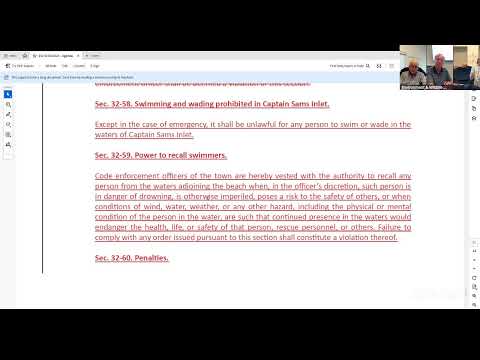
Separately, the committee moved a new prohibition on swimming or wading in the waters of Captain Sam’s inlet, except in emergencies. Joe explained the change removes the prior text that limited the restriction to when dolphins were present and makes the prohibition general, with an emergency exception for rescue or other urgent circumstances. The draft does not explicitly ban kayaks or paddle craft that only come ashore; members said signage would clarify permitted activities and locations.
The ordinance also expands code-enforcement authority: officers would be empowered to recall any person from the water when the officer determines the person is imperiled or poses a risk to others, or when conditions create a hazard. The draft includes cancellation grounds (hazardous weather, burn bans, declared emergencies) and field revocation authority when a permit-holder is violating conditions or is creating a safety threat.
The committee discussed operational details — how SAPOA’s authorization and the town permit will interoperate, whether the fire department will receive daily permit lists, and building a shared record of warnings or violations. Members asked the presenter to include recommendations about data-sharing and a suggested intergovernmental agreement in the committee’s cover letter to council.
The committee voted to report the ordinance to council as amended and to include recommended follow-up items in its report. The presenter noted an effective date should be delayed (he penciled in Jan. 1, 2026, as one option) to allow time for coordination with SAPOA, St. John's Fire District and other partners.
Next steps: The committee will report the item to council (committee members mentioned "the 28th" when scheduling the report) and recommended the town pursue intergovernmental coordination before the ordinance becomes effective.