Get Full Government Meeting Transcripts, Videos, & Alerts Forever!
Get email alerts on the Master Plan Housing topic
No spam. Unsubscribe anytime.
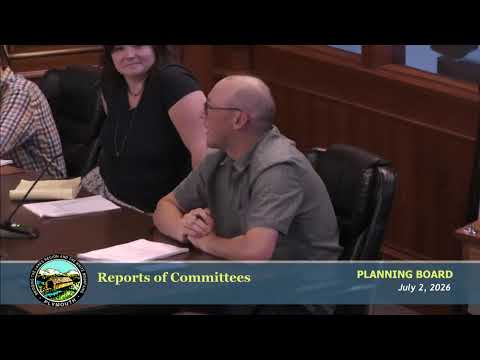
Planning board and Barrett Planning Group review draft housing chapter, debate zoning tools and accessibility
Summary
Consultant Judy Barrett led a page-by-page review of the draft housing master plan chapter. The board discussed upzoning, RSA 79-E, ADUs, 'child lots', universal design, elderly/continuing-care housing, and the assignment of implementation responsibilities.
The Plymouth Planning Board spent the bulk of its meeting reviewing a draft 'Housing' chapter prepared by Barrett Planning Group and discussing specific strategies the town could pursue to expand housing supply and improve affordability.
Judy Barrett, the consultant who prepared the draft, walked the board through recommended tactics and a 'responsibility' column the consultants asked the board to fill in. Barrett described zoning changes that can provide "an economic incentive through regulation," such as allowing more density in targeted zones or upzoning to encourage small-scale multifamily developments.
Board members debated where larger multifamily should be allowed. The Industrial Commercial District (ICD) was flagged as a possible place to permit larger-scale housing, provided that incompatible industrial uses are clarified or limited. Barrett noted that some ideas are already being advanced at the state level and advised careful local implementation.
The board discussed several regulatory tools:
- Residential incentives and RSA 79-E: Members reviewed RSA 79-E as a potential tool for residential revitalization and noted that town meeting approval may be required to enable certain incentives.
- Child lots and subdivision law: The board heard that current state law generally requires frontage on every lot, making 'child lots' (back-lot subdivisions without frontage) legally complicated; this is an item the group flagged for monitoring at the state level.
- Accessory dwelling units (ADUs) and multi-family in single-family zones: Members discussed allowing duplexes and triplexes by right in existing single-family districts or via special exception, noting recent state changes to ADU rules and owner-occupancy requirements.
- Universal design and age-friendly housing: Barrett urged integrating universal-design site and subdivision standards to support accessibility and 'age neighborhood' concepts across more zones rather than limiting them to agricultural areas.
- Elderly housing and continuing care: The board separated 'active-adult' 55+ concepts from higher-care assisted-living or continuing-care campuses, noting the latter require higher density and service packages and may need specific zoning or special provisions.
Other topics included incentivizing adaptive reuse of underused commercial buildings, working with land trusts (Pemibaker Land Trust) and regional development groups to inventory properties, lead-abatement and rehab funding awareness, and incorporating Complete Streets principles and low‑impact stormwater standards into subdivision rules.
Barrett said she will provide an editable Word version of the draft so the planning board can continue edits and fill the responsibility and timeline columns. The board agreed to continue refining the chapter and to coordinate with town administration and a future town manager on implementation.
Next steps: Barrett will edit the draft and return a revised version within two weeks; the board will continue to refine implementation responsibilities and may assign smaller working groups for follow-up.