Get Full Government Meeting Transcripts, Videos, & Alerts Forever!
Get email alerts on the Housing Affordability topic
No spam. Unsubscribe anytime.
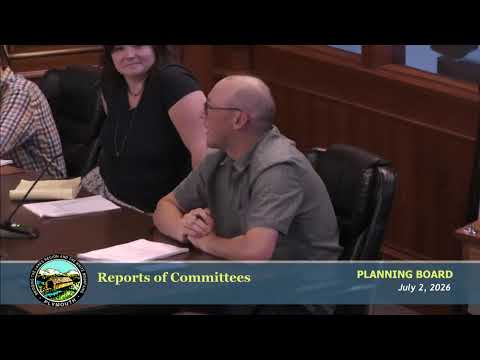
Planning board hears details, concerns about Elm Grove request for CDBG-backed rehab of Plymouth Apartments
Summary
At its July meeting, the Plymouth Planning Board discussed a request from Elm Grove Companies for the town to apply for HUD Community Development Block Grant funds to support rehabilitation of the 66-unit Plymouth Apartments. Board members pressed for details on how many units are currently market rate, potential displacement, and how the town would manage CDBG compliance.
The Plymouth Planning Board reviewed a proposal to use federal Community Development Block Grant (CDBG) funds to rehabilitate the 66-unit Plymouth Apartments on Morgan Drive, a project Elm Grove Companies has asked the town to support by applying for and receiving the grant on the developer’s behalf.
Joseph, planning staff, told the board that Elm Grove is proposing a financing package that would combine USDA rural development financing, low-income housing tax credits (LIHTC) and CDBG funds. "The town would have to meet all of the requirements of receiving CDBG funds even though Elm Grove would really do the project," Joseph said, explaining the town would be the formal grant recipient while Lakes Region Planning Commission (LRPC) would administer the grant and Elm Grove would be a subrecipient or borrower under a forgivable loan structure.
That arrangement prompted questions about legal and financial responsibility. "If Plymouth is signatory to a grant agreement, the grant is actually to Plymouth and then you're subgranting it to the nonprofit," Judy Barrett, the consultant from Barrett Planning Group, reminded the board, adding that being the recipient carries compliance obligations. Barrett also emphasized that LRPC’s role as administrator could reduce day‑to‑day burden on town staff but would not remove the town’s ultimate accountability for CDBG compliance.
Board members repeatedly pressed Elm Grove’s team — and the staff packet — for basic program details that have not been provided in writing. "Please submit that question in advance so there's not a 'gee, I don't know the answer' at the public hearing," one member urged, requesting a clear count of how many of the 66 units are currently market rate versus income-restricted. The project narrative in the packet notes some units have restrictions that convert to market rate on vacancy; board members said the current breakdown was not specified.
Joseph summarized the proposed affordability framework: Elm Grove plans to use income averaging across the property so the project would meet a 60% area median income (AMI) average requirement when combining CDBG and LIHTC rules. "They expect to have a range of some that may go below 60% and some that may go above in order to meet that income averaging at 60," Joseph said. Board members noted the need for Elm Grove to clarify whether affordability controls are time-limited (expire on turnover) or bound to a period specified in financing agreements.
Concerns about tenant displacement and relocation obligations surfaced repeatedly. Judy Barrett said that projects involving CDBG funds trigger the federal Uniform Relocation Assistance and Real Property Acquisition Policies Act and that "they cannot force the market-rate tenants to leave unless they want to pay relocation assistance" if relocation is required under the program. Still, members asked what housing choices would be available to existing residents during renovation and whether the project would effectively shift housing from one income group to another.
The packet included a draft Housing and Community Development (HCD) plan prepared using an LRPC template; Joseph said LRPC and Elm Grove will appear before the select board’s public hearing on July 13 to answer these questions. Board members asked that Elm Grove supply a clear unit-by-unit breakdown and the proposed affordability term sheet ahead of that hearing so the select board and the public can evaluate potential trade-offs.
Next steps: the select board will hold a public hearing on July 13 where Elm Grove and LRPC are expected to present details. Planning staff told the board they will ask Elm Grove to supply the missing unit counts, the proposed term length for affordability controls, and the proposed compliance/enforcement mechanism tied to the forgivable loan prior to that hearing.