Get Full Government Meeting Transcripts, Videos, & Alerts Forever!
Get email alerts on the Land Use And Building Codes topic
No spam. Unsubscribe anytime.
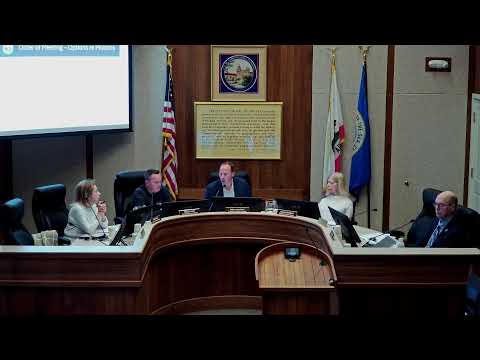
Carmel-by-the-Sea Board of Appeals pauses decision in coffee-shop occupancy dispute, schedules follow-up within 30 days
Summary
The Board of Appeals agreed to continue an appeal by the operator of Mad Dogs and Englishmen after hearing competing technical interpretations on whether added coffee service changed the business’s occupancy and therefore triggers an accessible restroom and fire-sprinkler requirement; the board asked for expert testimony and new documents ahead of a hearing to be scheduled within 30 days.
The Carmel-by-the-Sea Board of Appeals voted on June 1 to continue an appeal by the operator of Mad Dogs and Englishmen, asking the appellant to provide additional technical documents and to bring two expert witnesses for a follow-up hearing to be scheduled within 30 days.
The board’s move followed competing technical claims over whether the business’s addition of a coffee/bar area transformed a mercantile (retail) space into a business/assembly use that would require an accessible restroom on-site and installation of an automatic fire-sprinkler system under local amendments to the fire code. Ms. Blevins, the appellant, said architect‑stamped drawings and independent reviews by retired state fire officials show there was no change of occupancy; city staff and the fire marshal said their review shows an intensified occupancy that triggers sprinkler and restroom requirements.
Why it matters: the determination affects whether the space must be retrofitted with an accessible restroom and a fire-sprinkler system. City staff and the fire marshal said those upgrades can be expensive and are intended to protect life safety in denser occupancies; the appellant says the technical evidence her team submitted shows the primary occupancy remains mercantile and that the code has been misapplied.
During Tuesday’s hearing, Jamal Lowry, the city’s building official, laid out staff’s timeline and code interpretation. Lowry told the board that plumbing and electrical permits for the tenant improvements were issued in February 2024 and that planning approved a specialty restaurant use permit on Dec. 11, 2024. Lowry said the aggregate accessory‑occupancy limit (10% of floor area) and the building‑code occupant‑load calculations indicated an increase in occupant load — from a calculated 24 under the prior classification to a current maximum of 47 — and that under those calculations an accessible restroom and sprinklers would be required. "Staff recommends the Board of Appeals adopt the resolution . . . denying the appeal filed by Jennifer Blevins and upholding the building official's requirement to construct [an] accessible restroom and install a fire sprinkler system in the space," Lowry said.
Fire Marshal Justin Cooper told the board he consulted the State Fire Marshal’s office and that the change from a mercantile to a B (business) occupancy requires compliance with the fire code and local amendments. "Yes, they are required to follow the fire code," Cooper said of the change-in-occupancy question; he added that Carmel’s local amendment lowers the sprinkler threshold to 500 square feet and that the space at issue exceeds that limit.
Ms. Blevins, the appellant, disputed that conclusion and urged the board to focus on narrow code interpretation. She said she submitted architect‑stamped drawings and had independent review by two retired state fire marshals and a licensed architect, and that those consultants concluded "there is no change of occupancy." "This decision could actually force a shutdown of my business," she told the board, asking for time to present experts who could rebut staff’s findings.
Appellant’s architect David Beacham of Fuse Architects summarized an occupancy study arguing the accessory assembly area holds fewer than 50 people and is less than 750 square feet, making it accessory to the primary mercantile occupancy rather than a standalone assembly or business use. "Based upon our overall analysis . . . there is no change of occupancy," Beacham told the board.
Public commenters were split. Nearby restaurant owner Wasim Al‑Sharani told the board that customers use his restroom and that the coffee service has increased foot traffic and garbage problems; former mayor Steve Dallas said the State Fire Marshal determination carries weight and urged caution about legal exposure if city actions are inconsistent across businesses.
After hearing testimony, board members discussed whether to allow supplemental testimony and documents. The panel first considered denying a continuance while reserving the right to allow additional testimony at the hearing’s end (an earlier procedural motion that passed by a 3–1 vote). Ultimately the board voted to continue the hearing (the final motion) and to require the appellant to file any additional documents at least five days before the new hearing date. The motion to continue and set the follow-up within 30 days passed on a roll call.
What’s next: the board instructed Ms. Blevins to submit the additional documentation five calendar days before the rescheduled hearing and invited the appellant’s identified experts to testify in person or remotely. The follow-up hearing will be limited to the new materials and expert testimony; no final decision on the appeal was made Tuesday.
The dispute centers on code interpretation and the local amendment that sets a 500‑square‑foot sprinkler threshold. Staff and the city’s fire official say the code and the city amendment require retrofits when occupancy and use intensify; the appellant says the stamped plans and expert reviews show accessory use and no change of primary occupancy. The board’s continuance gives both sides time to present focused technical evidence before the panel issues a final ruling.