Get Full Government Meeting Transcripts, Videos, & Alerts Forever!
Get email alerts on the Employee Handbook topic
No spam. Unsubscribe anytime.
Hardeeville council workshop reviews proposed employee handbook updates on grievance process, travel and PTO
Summary
City staff presented a proposed rewrite of the City of Hardeeville employee handbook at a Feb. 24 workshop, recommending an open-door dispute process (not a formal grievance committee), upfront travel checks using GSA per-diem rates, expanded bereavement leave and faster PTO accruals to aid retention; staff said they will provide fiscal impacts before adoption.
City of Hardeeville staff on Feb. 24 presented a consolidated rewrite of the municipal employee handbook that would codify an open-door dispute-resolution process, change how travel reimbursements are handled, increase bereavement leave and adjust paid-time-off accruals to better align with public-safety shift schedules.
Assistant City Manager Neil Parsons told the City of Hardeeville City Council workshop the handbook revision was the product of a 12-month, page-by-page review by a multi‑department work group that used a MASC template, compared neighboring municipalities and obtained labor-attorney review. "We went page by page line by line," Parsons said, describing the year-long effort to make the handbook more concise and current.
Pam, the staff presenter, outlined the substantive policy changes. On dispute resolution, staff proposed an "open-door" process that records a formal avenue for employee complaints and keeps final supervisory authority within the council‑manager structure rather than creating a separate grievance committee. Pam said outside counsel advised against forming a formal grievance committee for this city given the council‑manager form of government; unresolved matters would escalate up the chain of command and, if necessary, to the manager (referred to in discussion as Josh).
On travel, staff recommended moving from receipt-by-reimbursement to pre‑authorized, up‑front checks tied to General Services Administration per‑diem rates. "They will get a check upfront for their travel costs instead of having to keep up with all the receipts," Pam said, noting that first and last travel days would be paid at 75 percent in accordance with standard per‑diem formulas and that staff would provide links to the GSA schedules in the city’s online policy portal (PowerDMS) for ease of use. Finance staff requested a two‑business‑day processing window to prepare checks.
Bereavement leave is proposed to increase from three days to five days, with leave lengths matched to an employee’s scheduled shift (eight‑, 12‑ or 24‑hour shifts). Pam said the change was made "to allow our employees to grieve or breathe a little bit while they're trying to handle affairs during that time of need." The draft defines immediate family to include spouse, parent, child, grandparent, grandchild, siblings and in‑laws, and excludes extended relatives such as cousins, aunts and uncles.
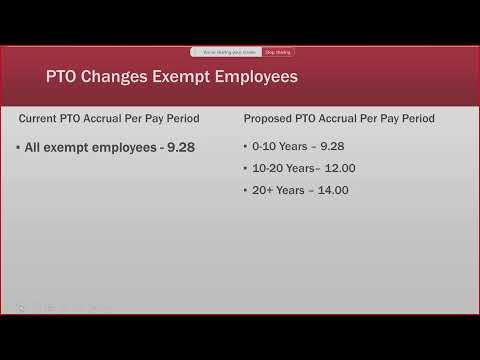
The largest substantive proposal affects PTO accruals. Staff proposed compressing the earliest accrual band (previously expressed for a wider years range) so employees earn leave sooner to aid retention and to make accruals proportional for public‑safety personnel working nonstandard shifts. Parsons said the change was intended to be fairer to 12‑ and 24‑hour shift workers who previously earned leave at a different rate than eight‑hour employees.
Staff described current maximum accruals and legacy exceptions: employees hired before Jan. 1, 2018, may accrue up to 720 hours; other employees have a stated maximum accrual of 480 hours. The transcript records discussion of a different maximum for public‑safety shift schedules, but the figure was not clearly stated in the record. Parsons also described a PTO donation bank and an employee leave buyback program (paid at a reduced rate) intended to reduce year‑end operational pressure and give employees options if they cannot use leave.
Council members asked clarifying questions about whether the handbook would include technology rules for social media and artificial intelligence. Staff said the handbook will summarize technology expectations and link to separate standard operating procedures; those SOPs will be maintained and navigable through PowerDMS.
Staff said the labor‑attorney review and departmental input had produced recommended edits and that the finance director (introduced as John Bo) would present the budget impact of the PTO and leave changes. The workshop record ends as the finance representative begins those remarks; staff said they will return with fiscal implications before any formal action.
No formal motions or votes were recorded in the workshop transcript. The council’s next steps, as described in the session, are for staff to provide detailed fiscal impact estimates and to post the handbook and supporting SOPs in the city’s electronic policy portal for council review and future formal consideration.