Get Full Government Meeting Transcripts, Videos, & Alerts Forever!
Get email alerts on the Bias Reporting System topic
No spam. Unsubscribe anytime.
Working group advances draft bias‑incident reporting system, sends recommendations to Select Board
Summary
The Concord Bias and Hate Incident Reporting Working Group voted to forward a draft reporting system to the Select Board after reviewing a reporting form, intake‑specialist duties, anonymity/confidentiality limits, a public dashboard and a proposed implementation timeline and budget estimate.
The Bias and Hate Incident Reporting Working Group voted June 15 to forward its draft reporting system and recommendations to the Concord Select Board, advancing a plan that includes multiple reporting modes, an intake specialist role, anonymity options and a public dashboard to track trends.
"The charge is advising the Select Board on development of a protocol to receive reports, document incidents, communicate with the public, and respond to anti‑Semitism and other bias and hate incidents," Paul Wong, chair of the working group, told members as he previewed the slide deck the group will present to the Select Board next week.
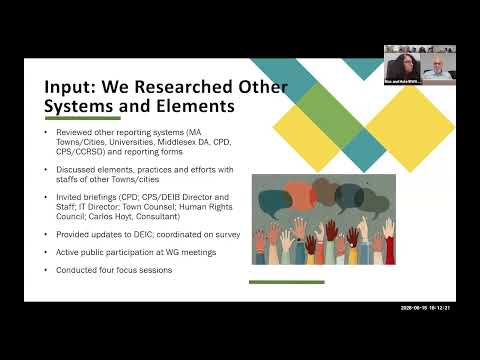
Wong summarized the group's core findings from focus groups and benchmarking: many bias incidents go unreported in their current form; existing reporting is fragmented across schools, police and other town channels; and fear of retaliation and concerns about confidentiality discourage reporting. To address those gaps, the working group proposed a multi‑modal intake system (online form and QR code, hotline to a human intake specialist, a dedicated email address and a walk‑in option) and recommended that the town staff a trained intake specialist to evaluate reports, provide resources, make referrals and perform limited follow‑up.
The draft form allows reporters to submit either anonymously or with contact details. The group agreed anonymity can be supported in the form, but members and the town archivist cautioned that anonymity is not the same as confidentiality under Massachusetts public‑records rules. "We can guarantee anonymity for somebody who wants it. We can't guarantee confidentiality, but there are ways to redact," Wong said, recounting advice from the town archivist and stressing the need for formal legal review before the Town releases forms or guidance.
The proposed intake role would be staffed by town personnel; duties described include evaluating incidents, responding to reporters, making referrals to town departments or outside agencies (for example, human‑services providers, the state civil‑rights offices or law enforcement) and entering data into a management system. The working group recommended a timely initial response — the group discussed aiming for an initial check‑in within 24 hours where feasible — and a later follow‑up (for example, at six months) to capture outcome information when reporters are willing to share it.
Members discussed whether intake staff would be mandated reporters in certain cases (for example, suspected child abuse or vulnerable‑adult neglect). The group did not set final staffing assignments; it recommended that the town manager identify appropriate staff, define required training and ensure intake personnel know when to 'hit the red button' and refer criminal or mandated‑reporting cases to the proper authorities.
Wong showed a prototype public dashboard intended to report incident counts, response rates and trends over time. The group characterized the dashboard as a diagnostic tool to measure community‑reported incidents and response performance rather than a mechanism that would by itself 'solve' bias in town. Budget estimates presented to the group described modest setup costs (software licenses and a short IT setup) and an ongoing staffing estimate of roughly 0.25 full‑time equivalent, with actual costs depending on report volume.
Committee members signaled a desire for preliminary survey data to be included in the Select Board briefing; the group said the community survey the committee fielded had drawn roughly 500 responses to date but remains open and could be summarized as preliminary if shown at the board meeting.
At the close of its meeting the working group approved a motion to move forward with the package and will present the slides and recommendations to the Select Board. The group also recommended legal review of the forms and records‑management provisions and a public forum this fall (the League of Women Voters' September venue was discussed) to solicit further public input.
The working group framed the proposal as an iterative pilot: build the intake form and dashboard, train staff, monitor reporting and response metrics, and revise procedures as the town gains experience.